
We hardly need to be reminded that these are challenging economic times for the country.
Virtually every area of the UK has been affected and this has had a knock-on effect on employment levels.
However, the Midlands still has a fairly high number of major employers, although in sectors that are slightly different from the ones on which the region’s wealth was built.
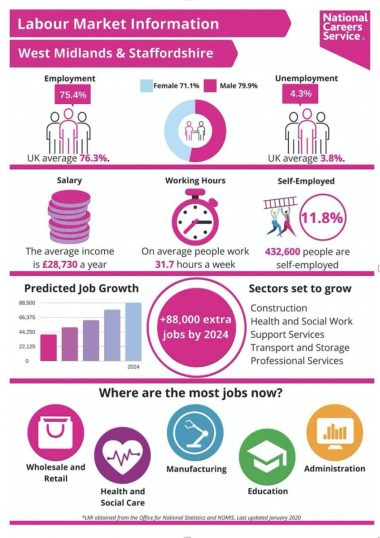
As most people know, the area was the birthplace of the Industrial Revolution and for centuries was reliant on heavy industry and manufacturing. As the heart of the British car industry, this was also where many of these related sectors from component manufacture to production itself came together. While manufacturing still exists in the region, its nature has changed. Other sectors have also risen to take its place and employment levels are set to grow with almost 90,000 new jobs due to be created by the end of this year.
Tourism has also increased in importance for the area with many people now employed in this and the hospitality sector, for example working in hotels, restaurants, and casinos.
The economic challenges have resulted in many people reigning in their spending which has made things tougher for the hospitality industry.
Here are some of the key areas in which much of the employment is to be found in the Midlands and these are as follows.
1. Retail
Of all the big names in retail based in the Midlands, one outstrips the rest. Boots was first established back in 1849 in Beeston, Nottingham by Jesse Boot. Today it employs over 45,000 people and has 2,000 branches. In terms of job opportunities it offers these are wide and varied. They range from retail roles to pharmacists, opticians, and even some in dentistry as it has sought to expand the services offered. Like most physical retail stores it has faced challenges in the last few years and has undergone a certain level of rationalisation. However, sales growth has been healthy – no pun intended – so it is likely to continue adding to its employee numbers in the future.
2. Telecoms

Photo: Pixabay
Anyone looking for openings in the telecoms sector is also in for some very good news. Ever since 2020 BT Group has had its regional hub at the prestigious Three Snowhill in Birmingham’s central business district. The company employs almost 5,500 directly in the region as well as providing work for around 600 contractors. There are many different opportunities within the organisation including software developers, sales executives, and HR professionals. The company has ambitious plans for the future, including supplying full fibre broadband to 25 million premises by the end of 2026 as well as to become the UK’s leading 5G network provider.
3. Financial
There was a time when the UK was home to a large number of building societies. These are organisations whose prime aim has always been to lend money for mortgages as well as to provide a place for people to keep their savings. Owned by their members, not shareholders, they are known as mutual societies. Today far fewer remain, but the second largest in the country, with assets of over £60 billion, is the Coventry Building Society. It has a total workforce of around 3,000 people from branch staff to economists and fraud protection experts to financial advisers. It’s also very active in the community making generous charity contributions as well as sponsoring the Coventry Building Society Arena, formerly the Ricoh.
In May 2024 it was announced that, subject to approval, CBS would be buying The Co-Operative Bank for £780 million. If the deal goes through it stands to become one of the country’s biggest high street lenders.
4. Healthcare

Photo: Pixabay
It comes as no surprise that the country’s biggest employer, the NHS, is also one of the main ones in the Midlands.
Due to open later this year, the Midland Metropolitan University Hospital is set to provide even more employment opportunities covering nurses, doctors, and many different kinds of ancillary staff.
The new hospital is located between Sandwell and West Birmingham and will be the region’s new hub for emergency and acute care, replacing the existing Sandwell and City Hospitals’ acute and emergency departments.
5. Gambling and Gaming
Casinos have been a mainstay in the West Midlands for some time now, with Birmingham having multiple options. Along with directly employing dealers and staff, they also contribute by growing the wider local economy through tourism, as those from the surrounding areas come to visit them.
However, casinos are coming under increased pressure from their online counterparts. Gamblers are opting to avoid the expensive overheads found at a land-based venue and instead are taking advantage of sites like casino.org/uk/ as a way to play online while saving some money on going out.
While some may see this as a negative for the region, as more casinos move online, some call it an opportunity. The Midlands is home to many exciting gaming development companies, that have gained contracts to help develop these online systems. Only time will tell where this sector goes next within the region.
6. Higher Education
Last, but not least, the region’s many universities are major employers for everyone from lecturers to administration staff. Many of the educational establishments are recognised centres of excellence. For example, the University of Wolverhampton holds this title for health and care while Loughborough has produced many famous sportspeople including Sebastian Coe, Mary Earps, and Tanni Grey-Thompson.
Looking to the future, the employment market in the Midlands looks buoyant, and not just with these major employers. If and when HS2 does go ahead it will only go to improve the situation even further. So, there are grounds for optimism on all fronts.
Article written by Ryan Leigh.