
THE COVENTRY MPs said they would be voting against the Terminally Ill Adults (End of Life) Bill which is going before the House of Commons this afternoon.
All three Coventry MPs – Taiwo Owatemi (Coventry North West, Zarah Sultana (Coventry South) and Mary Creagh (Coventry East) voted aginst the bill which made it through by 330 votes to 275.
Ms Owatemi and Ms Sultana have also published letters on their social media accounts explaining their decisions prior to the vote.
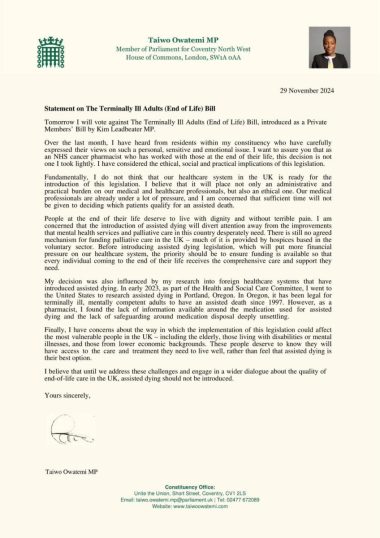
Ms Owatemi said she would vote against The Terminally Ill Adults (End of Life) Bill, introduced as a Private Members’ Bill by Kim Leadbeater MP.
“Over the last month, I have heard from residents within my constituency who have carefully expressed their views on such a personal, sensitive and emotional issue.
“I want to assure you that as an NHS cancer pharmacist who has worked with those at the end of their life, this decision is not one I took lightly. I have considered the ethical, social and practical implications of this legislation.
“Fundamentally, I do not think that our healthcare system in the UK is ready for the introduction of this legislation. I believe that, it will place not only an administrative and practical burden on our medical and healthcare professionals, but also an ethical one.
“Our medical professionals are already under a lot of pressure, and I am concerned sufficient time will not be given to deciding which patients qualify for an assisted death.
“People at the end of their life deserve to live with dignity and without terrible pain.
“I am concerned that the introduction of assisted dying will divert attention away from the improvements that mental health services and palliative care in this country desperately need. There is still no agreed mechanism for funding palliative care in the UK – much of it is provided by hospices based in the voluntary sector.
“Before introducing assisted dying legislation, which will put more financial pressure on our healthcare system, the priority should be to ensure funding is available so that every individual coming to the end of their life receives the comprehensive care and support they need.”
Ms Owatemi’s letter in full is below.
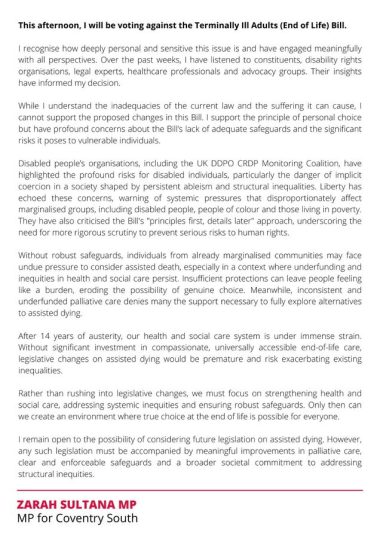
Ms Sultana said: “I recognise how deeply personal and sensitive this issue is and have engaged meaningfully with all perspectives.
“Over the past weeks, I have listened to constituents, disability rights organisations, legal experts, healthcare professionals and advocacy groups.
“Their insignts have informed my decision.
“While I understand the inadequacies of the current law and the suffering it can cause, I cannot support the proposed changes in this Bill.
“I support the principle of personal choice but have profound concerns about the Bilis lack of adequate safeguards and the significant risks it poses to vulnerable individuals.”
She added organisations, which supported disabled people, had ‘highlighted the profound risks for disabled individuals, particularly the danger of implicit coercion in a society shaped by persistent ableism and structural inequalities’.
“Liberty has echoed these concerns, warning of systemic pressures that disproportionately affect marginalised groups, including disabled people, people of colour and those living in poverty
“They have also criticised the Bills ‘principles first, details later’ approach, underscoring the need for more rigorous scrutiny to prevent serious risks to human rights.
And she said: “Without robust safeguards, individuals from already marginalised communities may face undue pressure to consider assisted death, especially in a context where underfunding and inequities in health and social care persist.
“Insufficient protections can leave people feeling like a burden, eroding the possibility of genuine choice.
“Meanwhile, inconsistent and underfunded palliative care denies many the support necessary to fully explore alternatives to assisted dying.”
See below to read the rest of Ms Sultana’s letter.
Background to the bill – how we got to this stage
The legislation going through UK Parliament is officially known as: ‘The Terminally Ill Adults (End of Life) Bill 2024-25’.
Its long title is: ‘A Bill to allow adults who are terminally ill, subject to safeguards, to be assisted to end their own life; and for connected purposes’.
Since the announcement was made that the bill, brought by Kim Leadbetter MP, would be coming to Parliament, there has been much debate – both in the media and in households up and down the country.
Decisions on ending lives would ‘allow adults who are terminally ill, subject to safeguards and protections, to request and be provided with assistance to end their own life’.
Friday’s sitting will be the bill’s second reading and the government will ‘remain neutral’ on the bill, enabling MPs to have a free vote, according to their own view on whether it should go to the next stage.
As the law stands
While suicide and attempted suicide are not criminal offences, it is an offence (in England and Wales) for a person to intentionally encourage or assist the suicide (or attempted suicide) of another – under the 1961 Suicide Act.
The aims of the bill
The bill is aimed at enabling adults – aged 18 and over – who have mental capacity, are terminally ill and are in the last six months of their life, to ask for a doctor to assist them in ending their life.
The safeguards and process
A substantial amount of criteria must be met by the applicant before they would be allowed to bring an end to their life – they must live in either England or Wales and each request must be assessed by two doctors, at least seven days apart.
The person must also have a ‘clear, settled and informed wish to end their own life’ and had reached the decision voluntarily, without coercion or pressure. If both doctors state, independently of one another, that the eligibility criteria have been met, the person may apply to the High Court for approval of their request.
If the High Court decided the applicant met the requirements of the bill, there would be a 14-day reflection period (this would be shortened to 48 hours if death is imminent).
After this time, the applicant may make a second declaration to request assistance to end their life. If the doctor continues to be satisfied that the person meets the eligibility criteria, a life-ending ‘approved substance’, to be self-administered, would be prescribed.
A person who provides assistance to another in accordance with the bill would not face any criminal (or civil) liability, and the Suicide Act 1961 would be amended accordingly. The section 2 offence would continue to apply to assistance falling outside the framework in the bill.
So where do you stand?
We want to know what your view is on the ‘The Terminally Ill Adults (End of Life) Bill 2024-25’. Would you vote for, against or are you unsure? Let us know your views by voting below.
Further reading
To read more on The Terminally Ill Adults (End of Life) Bill 2024-25, click here.