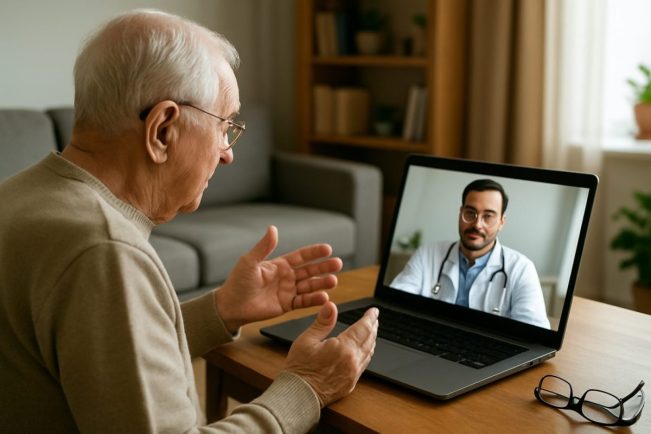
A major government push to expand remote monitoring across the NHS is set to change how thousands of patients receive care, with ministers promising faster, more convenient treatment from home.
But while officials hail the rollout as “care fit for the 21st century,” some local residents say they worry it may make it even harder to see a doctor face-to-face.
The announcement follows a government announcement confirming that dozens of pilot schemes across England will soon allow patients to submit health updates directly to specialists using the NHS App. The technology will record information such as blood pressure, oxygen levels and symptoms, aiming to detect problems earlier and free up face-to-face appointments.
Health and Social Care Secretary Wes Streeting said:
Patients expect care fit for the 21st century and that’s what I’m determined to deliver. This is a government that puts the NHS and patients first as our record investment in the service shows.
Using tech to bring care closer to home frees up hospital appointments for those who truly need them and makes life simpler for everyone. That’s our mission: care that’s easier, faster, and always within reach.
Through innovative approaches like this and NHS Online – which will digitally connect patients to expert clinicians anywhere in England – we are building a smarter NHS all while easing pressures on busy hospitals and stretched staff.
The government says the full rollout could free up around 500,000 appointments each year, easing pressure on hospitals ahead of winter. Several NHS trusts across England will trial the technology in areas such as respiratory care, cardiology, urology and prostate cancer follow-up.
The NHS is also launching what it calls a “world-first” trial for people living with motor neuron disease (MND). Led by Sheffield Teaching Hospitals, the study will test whether ventilator support can be safely monitored and adjusted remotely.
Dr Ian Eardley, National Clinical Director for Elective Care at NHS England, said:
“Right across the country the NHS is harnessing the latest technology to ensure people can get the care they need more quickly and conveniently, and closer to home.”
Local Reaction Mixed
In our area, the changes have sparked both enthusiasm and unease.
Mrs M Clarke, 62, who has a long-term respiratory condition, welcomed the move.
“If I can send my readings from home instead of waiting weeks for an appointment, that’s brilliant. I’m all for anything that stops me trekking to the hospital unnecessarily,” she said.
Others, however, worry the shift may come at a cost.
D Proctor, 47, said:
“They keep calling it progress, but it feels like a way of keeping people away from doctors because the wait lists are out of control. If something’s wrong, I want to see a real person, not fill out another form on an app.”
A local nurse, who wishes to remain anonymous, offered a more balanced view.
“Remote monitoring can genuinely help free up time for the patients who need hands-on care most,” she said. “But it will only work if the NHS protects in-person appointments for people who really need them. Technology should support care, not replace it.”
A Question of Access
Some residents also raised concerns about digital inclusion. An elderly resident (82) told us:
“Not everyone has a smartphone or feels confident using apps. I hope the NHS remembers that before everything moves online.”
Researchers leading the MND trial say they are aware of such barriers. Dr Esther Hobson, of Sheffield Teaching Hospitals, said:
“We’re especially interested in the experiences of people who find it hard to access NHS care to make sure everyone can get the benefits.”
What Happens Next?
The pilots will run across England in the coming months and feed into a wider government plan to expand remote monitoring for all long-term conditions. Ministers say the technology will help modernise the health service as it moves from “analogue to digital.”
Whether it represents genuine progress or a step away from traditional care remains the question many local residents are now asking.
As Mrs Clarke says:
“If it helps people get seen quicker, great. But I just hope it doesn’t become harder to look a doctor in the eye when you need to.”
Main Image: For illustration purposes only.