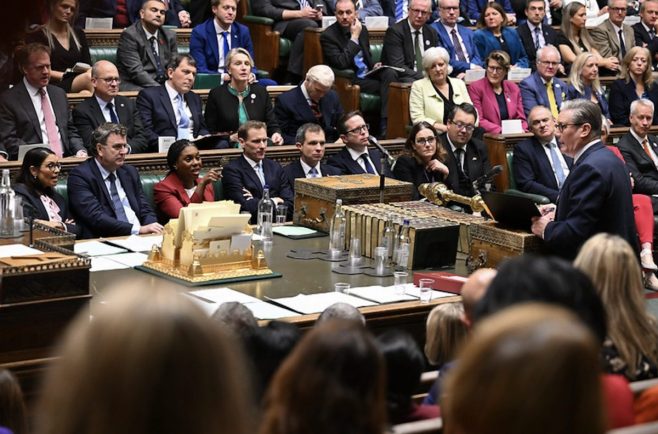
Key exchanges from this week’s Prime Minister’s Questions:
Prime Minister Keir Starmer began this morning’s session of Prime Minister’s Questions by congratulating Scotland on qualifying for the World Cup for the first time in twenty eight years, before offering thoughts for those affected by recent flooding.
The opening came against the backdrop of unrest inside Labour over possible Budget decisions, including pressure regarding the two child benefit cap.
Assisted Dying Bill Raised Early in the Session
The first significant policy question came from Conservative MP Kit Malthouse, who asked whether procedural moves could delay or block the Assisted Dying Bill. Sir Keir replied that the legislation was a matter of conscience and ultimately a decision for Parliament, although the Government had a responsibility to ensure any bill was workable.
Badenoch Presses Starmer Over Unravelling Budget
Kemi Badenoch then launched the first of several challenges over Labour’s tax plans. She asked why the Government appeared to be signalling changes to income tax rates, only to walk them back, claiming the Budget was “unravelling before it is even delivered”.
Sir Keir responded that the Budget would be presented next week, adding that Labour planned to focus on reducing NHS waiting lists, cutting debt, and easing living costs.
Repeated Questions About Income Tax Thresholds
Mrs Badenoch returned to the issue repeatedly, asking four times whether Labour would freeze income tax thresholds, something that would contradict the Government’s previous statements and breach the manifesto. She reminded the House that the Chancellor had explicitly promised to unfreeze thresholds in her Budget speech.
The Tory leader asked: “The Prime Minister needs to come clean, can he confirm that he won’t break another promise by freezing income tax thresholds?”
Keir Starmer did not give as answer, saying only that the Government’s plans would be set out next week and insisting that Labour would avoid austerity. He said: “The Budget is one week today, and we will lay out our plans. But what we won’t do, Mr. Speaker, I’ve said what we will do in terms of protecting the NHS and public services, what we won’t do is inflict austerity on the country as they did.”
Starmer Accuses Tories of Following Reform
In a separate exchange, the PM accused the Conservative Party of mirroring Reform UK on several policies, including energy and the European Convention on Human Rights. He said Mrs Badenoch had dismissed previous comments from one of her own shadow ministers about deportation on cultural grounds.
In referring to Mrs Badenoch, Mr Starmer said: “She talks about policy and approach on energy policy, she follows Reform. On the European Convention, she follows the man who wants her job.
He added: “And when her shadow minister said we should deport people here to achieve cultural coherence, she pretended that it didn’t happen.”
Badenoch’s “Government by Guesswork” Claim
Pressing the point further, Mrs Badenoch accused Sir Keir of “government by guesswork”, arguing that changes around tax policy indicated confusion inside Labour. Mrs Badenoch said: “Two weeks ago, the Chancellor called a ridiculous press conference to blame everyone else for her having to raise income tax. Then last week, she U-turned on her own U-turn.
“Instead we can see they’re trying to freeze income tax thresholds, something she said last year would be breach in their manifesto. “They are making it up as they go along. Doesn’t the country deserve better than government by guesswork?”
She said the public deserved clarity rather than repeated shifts in position.
International Men’s Day Question
Labour MP Luke Charters used his question to speak openly about mental health struggles that followed complications during the birth of his first child. Sir Keir praised him for his honesty and said such contributions were important across the political divide. The intervention coincided with the Prime Minister’s launch of a men’s health strategy.
Smartphone Ban in Schools
Sir Keir was then asked why he would not support a statutory ban on smartphones in schools. He said that the majority of schools already enforce their own restrictions, adding that the Government would keep the matter under review but should focus on measures that are effective in practice.
Lee Anderson Interrupted Over “Dog Whistle Politics” Claim
Reform UK chief whip Lee Anderson accused Labour of engaging in “dog whistle politics”, prompting laughter across the chamber and a brief intervention from Speaker Lindsay Hoyle. Jeremy Corbyn, seated behind Mr Anderson, appeared to start shouting.
PMQs Tone Questioned
Sir Keir also faced criticism from a Conservative backbencher who challenged the tone he had adopted during the session.
Badenoch Warns of “Stealth Tax Bombshell”
Outside the chamber, Mrs Badenoch continued her attack, accusing Labour of preparing a “stealth tax bombshell” ahead of next week’s Budget. She argued that Sir Keir’s refusal to rule out a threshold freeze confirmed that Labour was preparing to raise taxes despite its manifesto commitments.
Starmer Declines to Intervene in Telegraph Sale
The final significant exchange concerned the sale of The Telegraph. Mike Wood, the Conservative MP for Kingswinford and South Staffordshire, urged the Prime Minister to intervene in order to prevent the paper from being burdened with potentially unsustainable debt.
He warned that the collapse of RedBird Capital Partners’ two year pursuit of the titles had created a risk that the newspaper could be left responsible for substantial liabilities if sold for less than five hundred million pounds.
Sir Keir acknowledged that uncertainty over the ownership of The Telegraph was a “serious issue”, but said he did not believe the Government should step in. When pressed on whether he would prevent the imposition of “toxic debt”, he replied that nationalisation was not appropriate.