
Online casinos grew from a niche experiment into a major segment of digital entertainment. This shift developed through steady technical progress, changes in user habits, and the rise of accessible gaming formats. People who once viewed remote play as a novelty now treat it as routine recreation. The transition unfolded step by step and formed today’s structured environment.
Early online gambling platforms offered limited graphics, simple rules, and few game categories. Users accepted these limits because the internet itself remained new. The appeal of remote access outweighed technical drawbacks. As web standards improved, developers introduced more stable software and reduced errors that once frustrated players. Mobile devices accelerated progress. Smaller screens forced designers to rethink interfaces and interaction patterns. Faster connections, lighter files, and adaptive layouts expanded the user base.
Today, online casinos operate as a complex digital sector with strong demand, varied designs, and ongoing regulatory debates. People who seek controlled entertainment choose these platforms because they fit short breaks, commutes, and evenings at home. Communities such as spinogambino demonstrate how users discuss tactics and share experiences in open environments.

Growth Factors That Shaped the Online Casino Sector
Several forces supported the rise of online casinos, each contributing to overall development.
Technical progress: Developers improved frame rates, refined interfaces, and created smoother interaction loops. Users now rely on clear menus, efficient search tools, and intuitive controls.
Mobile access: Smartphones allowed people to play during short pauses in daily routines, which increased global exposure.
Familiarity with digital transactions: Years of online shopping and streaming built trust in digital payments and made financial interactions feel normal.
Regulatory clarity: Some regions adopted clear guidelines, which created stable conditions and predictable rules.
These factors encouraged new game formats and made online gaming accessible to more people. Users began exploring remote platforms without needing physical venues, which reshaped expectations about convenience.
User Behavior in the Digital Casino Environment
User habits in online casinos differ from habits in physical venues. Remote play supports shorter sessions, more frequent breaks, and selective game choices. People choose games that match their available time, tolerance for risk, and interest in structured rules.
Most users prefer straightforward games with clear probabilities, especially during short breaks. Developers observed this behavior and created interfaces that allow fast entry and exit. Game information now includes plain-language explanations to help new users avoid confusion.
Some players analyze statistical trends. They track return-to-player percentages, volatility, and round frequency. These users rely on data rather than intuition. This analytical approach grows each year and encourages developers to present accurate information.
To illustrate this evolution, consider the following table:
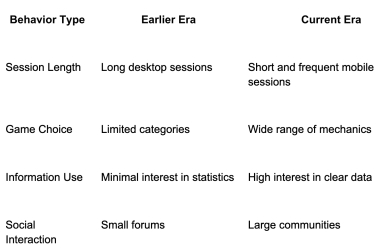
Users also rely on responsible gaming tools more than before. These include time reminders, deposit limits, and cooldown features. Platforms now treat these tools as core components rather than optional add-ons.
Game Design Trends and Their Influence
Game design changed significantly. Early titles offered fixed layouts and low-detail visuals. Modern design focuses on smooth interaction, readable graphics, and efficient feedback. These qualities help users understand outcomes without confusion.
Several clear trends define current development:
Improved clarity: Designers highlight results, payouts, and rules through simple layouts that reduce uncertainty.
Faster loading speeds: Improved compression allows quick launches and smooth transitions.
Adaptive interfaces: Layouts adjust to phones, tablets, and desktops without distortion.
Higher frame stability: Consistent performance supports long sessions and reduces technical distractions.
These trends improved the overall standard of online play. They also encouraged experimentation with formats not seen in physical venues, such as time-based rounds or variable difficulty modes. This expanded the range of options for users seeking specific engagement levels.

Regulatory Considerations
Regulation plays a major role in shaping online casinos. Clear rules help users understand what to expect from platforms. Many regions require transparent payout information, stable verification procedures, and responsible gaming features. These standards reduce uncertainty and support user trust.
Regional differences create challenges for developers, who must adjust payment methods, verification steps, and compliance rules depending on the target market. This adds complexity but also supports long-term reliability. When users know a platform follows consistent standards, they interact with more confidence.
Regulators increasingly emphasize transparency regarding probabilities. Games that display clear statistical information help users make informed choices and match their growing demand for accurate data.
Social Aspects of Online Casino Growth
Online casinos support new forms of social interaction. People gather in chat rooms, forums, and community groups to discuss strategies, mechanics, and patterns. These conversations shape user attitudes and create shared knowledge.
Social activity usually follows three types:
Information exchange: Users share data and interpretations.
Collective learning: Groups discuss budget management and game cycles.
Casual conversation: People talk about personal experiences and relax.
These interactions create a sense of community without competition or ranking. The culture surrounding online casinos now includes an informational dimension that did not exist years ago.
The Role of Research and Data
Research influences user behavior, platform design, and regulatory planning. Analysts study session frequency, volatility preferences, and the rise of mobile access. These findings help developers understand how users adapt to digital environments.
Researchers also measure the impact of guidance and control tools. Data shows that users prefer platforms that present clear information and offer accessible limits. Responsible gaming features now align with general expectations rather than acting as restrictions.
Developers, analysts, and regulators often review similar metrics:
- Return-to-player values
- Frequency of short sessions
- Mobile vs. desktop activity
- Use of control tools
- Game category distribution
A shared focus on data supports transparent environments and encourages fact-driven decisions.
Looking Ahead
Online casinos will continue to evolve. Developers plan to refine interfaces, increase clarity, and introduce formats suited to short mobile sessions. Payment systems will become more efficient, and verification processes will move toward faster checks while maintaining accuracy.
User expectations now include clear information, smooth interaction, and logical rules. As these expectations rise, platforms will build tools that respond to practical needs rather than trends.
Users also show growing interest in learning resources. Articles, guides, and statistical summaries help them make informed decisions. This suggests a future focused on education and accessible information.
The rise of online casinos reflects broader changes in digital entertainment. People choose flexible formats that suit everyday routines. Developers respond with streamlined software, and researchers track patterns to improve transparency. Together, these elements form a structured environment that continues to expand and refine itself.
This is a submitted article