If you believe the ads in January, half the internet suddenly transforms into the best dating services 2025, each one promising life-changing love and a flawless recommendation engine. But behind the glossy screenshots and “success stories,” online dating is a very real business with revenue targets, shareholders, and growth charts.
Understanding that business isn’t just interesting. It helps you understand why apps behave the way they do — and how to use them without being used.
Online Dating Is Not a Cute Little Niche
For years, people joked about online dating as a desperate last resort. Those days are over.
- Hundreds of millions of people worldwide use dating sites and apps.
- The industry generates billions in annual revenue.
- In some countries, meeting online has become one of the most common ways couples form.
In other words: this is no longer a side hustle. It’s a major, mature digital industry.
How the “Best Dating Services 2025” Actually Make Money
When a service is marketed as one of the best dating services 2025, it usually offers some mix of:
- free signup,
- paid upgrades,
- and “exclusive” features.
Behind that, the main money streams look like this:
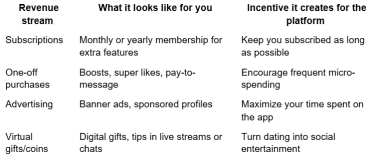
You pay with money, clearly. But you also pay with attention and data: every swipe, pause, match, and message is a datapoint.
What “Best” Means Depends on Whose Metrics You’re Looking At
For you, “best” probably means:
- I meet people who are actually compatible.
- I feel safe.
- I don’t go insane using the app.
- I can pause or quit once I find what I want.
For the company, “best” often means:
- high daily usage,
- strong growth in new users,
- good conversion from free to paid,
- low churn among paying subscribers.
There’s overlap — a miserable user will eventually leave — but the goals are not perfectly aligned.
A service that matched everyone perfectly in a week and then they all deleted the app would be a beautiful social project and a terrible business model.
Algorithms, Data, and the Gentle Push to Keep Swiping
Modern dating platforms don’t just show you random profiles. They’re constantly learning from you:
- What type of photos you linger on
- The ages, locations, and lifestyles you tend to like
- How often you respond to messages
- How quickly you get bored and disappear
That data is used to:
- Predict who you might like
- Decide when to show you someone “special”
- Time notifications so you come back just as your usage drops
- Test new features on you without you realizing it
None of this is automatically sinister, but it does create a subtle dynamic: the system is tuned to keep you engaged, not necessarily to help you leave happily partnered as soon as possible.
Scams, Safety, and the Cost of Trust
Where there is money and emotion, there are scammers.
- The industry has had to respond to:
- Catfishing and fake profiles
- Romance scams that target vulnerable people for money
- Harassment and abusive messaging
- Stalking and offline safety risks
Good platforms now invest in:
- Photo verification and ID checks
- Automatic detection of suspicious patterns
- Safety education and reporting tools
- Moderation teams and, in some cases, human match reviewers
All of that costs money and reduces short-term profit, but it preserves trust. Without trust, the product collapses.
Users: Customers or Inventory?
Here’s the uncomfortable thought: a dating app might see you in two ways at the same time.
- As a customer who pays for features.
- As inventory shown to other customers to keep them engaged.
That’s why it helps to think of yourself as an informed client, not just a user.
Questions worth asking yourself:
- What exactly am I paying for with this subscription? Visibility? Filters? Status badges?
- Does this feature genuinely help me meet better matches, or does it just make me feel like I’m doing something?
- After a month of using this app, do I feel more hopeful or more drained?
If you wouldn’t tolerate a gym that made you feel worse every time you left, don’t tolerate it from a dating app.
How to Navigate the Industry Without Losing Your Mind
Some practical, non-naive strategies:
- Use more than one model. Try at least one “serious” site with in-depth profiles alongside lighter, swipe-based apps. The mindset shift alone is interesting.
- Look at who they market to. If an app’s entire advertising is about partying, spontaneity, and “no strings,” don’t expect it to excel at deep compatibility.
- Read between the lines of pricing. If almost every useful feature is locked behind paywalls, ask yourself whether you’re joining a community or just entering a casino.
- Measure outcome, not dopamine. At the end of the month, forget how exciting the notifications felt. Ask: how many meaningful conversations or dates did I actually have?
The Future: More Niche, More AI, More Regulation
The next few years will likely bring:
- More niche platforms: for specific age groups, lifestyles, and values
- More AI features: better prompts, automated icebreakers, safety checks, even AI “dating coaches” inside apps
- More regulation, especially around underage users, data privacy, and scam prevention
The important thing to remember is this: online dating is not a lottery you have to passively buy tickets for. It’s an industry selling a service. When you understand how that industry works, you stop feeling like a victim of “the algorithm” and start behaving like what you are: a paying adult with choices.
The real “best dating services 2025” for you are the ones that respect your time, your boundaries, your safety, and your intelligence — not just the ones shouting the loudest in ads.