The speed of change in kabaddi is hard to overstate. Momentum suddenly shifts in a fraction of a second. A single raid can start a tidal wave of support for one side, and a huge tackle can lose support for the entire side. In Pakistan, kabaddi is a staple, and the champions are easily predicted because they can gauge shifts in support. Momentum is a huge part of kabaddi, and unlike almost any other sport, it is direct and unrelenting.
Why Momentum Matters More Than the Scoreline
As kabaddi gains more structured coverage and real-time visibility, fans increasingly follow matches through mobile platforms. When discussions turn to live updates and quick reactions, the phrase best betting app in Pakistan often comes up in the same breath as momentum shifts. That’s because kabaddi’s pace rewards instant awareness — a super raid or failed tackle can flip the game before anyone has time to reset expectations. Platforms that allow fans to track these moments closely make momentum easier to read, even when watching from a distance.
In kabaddi, the score often does not tell the full story. A team behind by a low number of points can be in full control of the match. They just need to have the defensive rhythm. Fans often look for defensive coordination, raid timing, and players’ body language. A successful block after some pressure can change the flow of the game, even if the score is not changing. A team ahead in the score can lose control simply because of a break in structure. The flow can change in how the teams respond; it is not only in the numbers.
The Power of a Super Raid
During high-pressure phases like all-outs or late defensive stands, attention sharpens, and emotions run high. In these moments, fans often engage with platforms using incentives such as a MelBet official promo code, not as a distraction but as part of the broader live-match experience. The key difference lies in timing — decisions made during emotional peaks tend to reflect momentum rather than logic. Experienced followers learn to recognize these moments for what they are: signals of shifting control, not prompts for rushed action.
A few moments shift momentum as sharply as a super raid. When a raider cuts through multiple defenders, the effect goes well beyond the points on the board. Defensive confidence takes a hit, and tactics often change immediately. The opposing side may become cautious or start second-guessing decisions, opening up space for further damage. Fans understand that a super raid leaves a mark that lasts far longer than the score it adds.
All-Outs Change the Mental Balance
An all-out is more than just a scoring event; it resets the mental side of the match as well. A team getting all out usually swings momentum. The side that gets an all-out feels more confident, while the all-out team has to mentally reset quickly. Even the most experienced teams find it hard to mentally reset in such situations. The fans know the importance of all-outs and closely watch the next couple of raids to see whether the momentum has shifted or if it will go back to the team that got all out.
While raids control momentum in shorter time frames, the defense controls it in longer time frames. A well-coordinated defensive unit can build control without needing a big moment. If a defender keeps getting a single tackle, it can force the raider to make a risky move. After a while, under that pressure, mistakes will start to happen, especially in kabaddi. Watching that
build up makes it easy for the moment to go all in. A great kabaddi fan knows that the momentum is driven by the defensive side.
Having an early lead while dominating can cause a team to lose everything in a microsecond. There is some early fatigue, poor substitutions to blame, misjudged aggression, or just bad luck that can flip the momentum out of nowhere, and it is usually the fans who notice the changes who take more experienced views of the game.
Key Signals Fans Watch During Matches
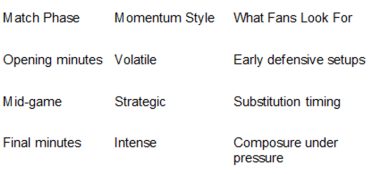
In the closing minutes, momentum becomes delicate. One failed raid can erase several minutes of control. Teams often swing between caution and desperation, and both extremes come with risk. Fans feel this tension instantly and can often sense where the match is heading before the final whistle. At this stage, composure outweighs tactics. Momentum isn’t driven by a single moment either — it’s read through a mix of signals.
Common momentum indicators include:
- Defensive success across consecutive raids
- Raiders are hesitating or rushing decisions
- Substitutions that stabilize or disrupt flow
- Crowd reactions influence tempo
These cues are more important than single highlights. The expectations change during the game with the fans. Kabaddi force is not always the same. It also acts differently depending on the phase of the game.
Why Momentum Is Felt Before It’s Seen
The tactical side of kabaddi is just as emotional as the spectators’ side of the game. Fans know when a team is holding back, when communication is lacking, and when confidence is changing. Even if the score doesn’t reflect the change, the fans know that something is happening. Fans experienced when reading matches, and quite often, know more than the score. There is a certain behavior that changes, and the fans feel it. There is a kabaddi momentum that leaves little room for error in everything from the mini games to the all-out.
For spectators in Pakistan, the kabaddi-momentum and behavioral chess are particularly rewarding. There is a tactical side to kabaddi, waiting for the right to be triggered. Almost always, the victor is the team that is more perceptive of kabaddi momentum.
This is a submitted article