
Leisure time in the UK has shifted from clearly defined periods to short, intermittent stretches between everyday tasks. People rarely sit down to plan entertainment rigorously because attention usually comes in spare moments rather than during scheduled breaks. Mobile phones fit naturally into this behaviour, remaining accessible without preparation. Content that performs well under interruptions stays relevant longer than formats requiring continuous focus. Slot-style mobile games have developed within this environment. Their layout follows how screens are held and how thumbs move, rather than mimicking how desktop systems once operated. This shift has shaped how mobile slot games in the UK are accessed, evaluated, and compared across licensed platforms designed for short, interruption-based leisure use. Sessions begin without a long setup and can pause when real life interrupts, mirroring broader digital behaviour where ease of access is paramount.
The Role of Mobile Slots in Modern British Leisure
Mobile entertainment is now part of everyday leisure across the United Kingdom. Smartphones handle transport planning, work communication, and payments, so leisure activity begins on the same screen without a change in settings. Slot-style titles fit into this routine not as events requiring planning, but as interactions occurring during commuting, waiting, or quiet evenings.Portability plays a central role because phones remove dependence on fixed spaces. Entertainment follows daily movement, explaining why mobile formats dominate digital participation. However, on licensed platforms, mobile slots UK operate under strict rules enforced by the UK Gambling Commission (UKGC). Access requires verified identity checks and age validation before gameplay becomes available. Advertising standards and safer gambling tools remain mandatory, ensuring that while access is convenient, it remains regulated.
Mobile Slot Discovery and Comparison on Smartphones
As mobile slot libraries grow, players increasingly compare games based on usability rather than just narrative depth. On smartphones, interface clarity, loading speed, and session flow matter immensely. Discovery becomes a process of finding formats that feel comfortable on smaller screens. From this perspective, curated overviews such as the mobile slots review help illustrate how mobile-first design choices appear across different titles and providers. These comparisons focus on accessibility, responsiveness, and layout efficiency, aligning with how mobile users evaluate games. Rather than committing to long sessions, players gravitate toward games that load quickly and remain stable during interruptions. Slot discovery on smartphones mirrors wider digital consumption habits shaped by time constraints and device ergonomics.
Technical Adaptation of Mobile Slot Machine Games on Smartphones
Mobile-first engineering defines how digital leisure software operates across the UK. Developers now design systems for handheld hardware first, rather than modifying desktop products. Modern mobile slot machine games rely on HTML5 frameworks, allowing instant access through standard mobile browsers (Safari, Chrome) while maintaining consistency across iOS and Android. This structure removes reliance on app stores while preserving performance.
Because network conditions vary, latency reduction is a priority. Many platforms route data through regional servers to reduce delay. Technical optimisation focuses on device efficiency rather than just visual intensity:
- Asset compression lowers memory demand during browser sessions.
- Capped frame rates limit processor strain and battery consumption.
- Touch mapping follows ergonomic studies measuring thumb reach zones.
With UK smartphone ownership exceeding 90% among adults, developers prioritise reliability and battery preservation over experimental graphics, ensuring smooth operation across everyday conditions.

Analysing Access Models: Demo Play and Free-to-Play Formats
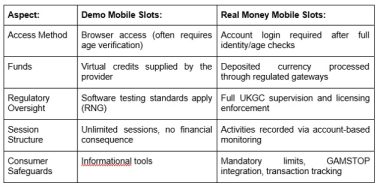
- Within the UK gambling framework, there is a strict separation between simulated gameplay and monetary participation. Licensed operators must distinguish between demo environments and real-money activity to avoid user confusion.
- Demo modes allow players to explore mechanics and volatility using virtual credits. Game behaviour mirrors paid versions—certified random number generators (RNG) and feature logic remain unchanged. For instance, exploring a title like the Big Bass Bonanza slot in demo mode illustrates how bonus rounds function without financial risk. However, under UK regulation, even free-to-play access on licensed sites often requires age verification to prevent underage interaction.
- Real-money mobile slot access operates within a controlled licensing environment. Every transaction and account function must comply with the Gambling Act 2005. Operators must hold a valid remote gambling licence, and compliance covers system security, data protection, and anti-money laundering controls.
Structural Differences in Mobile Access
The table below outlines the structural differences between demonstration formats and real-money mobile access on regulated platforms.
Regulatory Context for Mobile Slot-Style Games in the UK
Mobile slot-style games in the UK operate under the same rigorous rules as desktop gambling. Regulation focuses on who offers the games and how systems function. Mobile access does not reduce requirements; smartphones count as full remote gambling channels.
Licensing and Technical Standards: All real-money titles require a remote gambling licence. Operators must comply with Remote Gambling and Software Technical Standards, which define fairness and data security. External testing laboratories verify compliance before any platform certification.
Consumer Protection: Regulation requires identity confirmation before monetary participation begins. Platforms must provide adjustable deposit limits, session notifications, and inclusion within the national GAMSTOP exclusion network. Furthermore, customer balances must be segregated from operational business funds to ensure financial protection.
Mobile slot-style games have become a fixture of modern UK leisure, shaped by smartphone ubiquity and fragmented daily schedules. Entertainment now occurs during short intervals, placing mobile formats at the centre of digital use. Titles reflect this through lightweight design and quick access. However, this growth is underpinned by stringent regulation. From technical HTML5 adaptation to mandatory identity checks, the ecosystem is designed to balance convenient access with rigorous consumer protection standards.
Article by Evelina Brown.