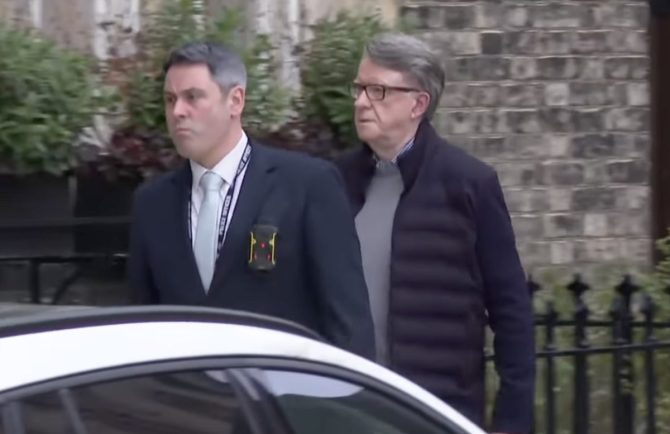
Lord Peter Mandelson has been released on bail after being arrested on suspicion of misconduct in public office, the Metropolitan Police said, following an investigation linked to newly disclosed material about his relationship with the late financier Jeffrey Epstein.
Police said a “72-year-old man arrested on suspicion of misconduct in public office has been released on bail pending further investigation”, adding he was arrested at an address in Camden, north London, on Monday 23 February, taken to a London police station for interview, and released in the early hours.
The case centres on allegations that Mandelson, while serving in Gordon Brown’s government, shared market sensitive information with Epstein, emails released in the United States are reported to include exchanges from 2009 and 2010 discussing planned policy measures and financial interventions, the Metropolitan Police investigation is continuing and consultations with prosecutors are understood to be ongoing.
Mandelson has denied wrongdoing, Reuters reported he was released on bail and has previously rejected claims he acted improperly.
The arrest has reignited criticism of the Labour government’s judgment in appointing him as ambassador to Washington in 2024, a role he later lost, Conservative leader Kemi Badenoch described it as “the defining moment of Sir Keir’s premiership”, adding, “Watching the man who he appointed to the highest position in our diplomatic service getting arrested by police is an image which I think is going to stay with us for many, many years to come.”
Ministers have said they intend to publish documents related to Mandelson’s appointment, while stressing they must not compromise the police investigation, speaking in the House of Lords earlier this month, the Leader of the House, Baroness Smith of Basildon, said the government’s approach was “to ensure that all available documents are made public, that what needs to go to the police does”, with publication overseen alongside “an independent King’s Counsel”.
In the Commons, a motion demanded the release of papers including “material the FCDO and the Cabinet Office provided to UK Security Vetting about Lord Mandelson’s interests in relation to Global Counsel”, and cited warnings of “potential conflicts of interest surrounding Global Counsel”, the lobbying and public policy firm he co founded.
Global Counsel has itself been thrown into crisis, Reuters reported the firm was preparing to enter administration amid client departures tied to the Epstein fallout, and that it had finalised the divestment of Mandelson’s shares earlier this month, ending his connection with the company.
That backdrop is now colliding with an increasingly bitter fight over the UK’s agreement with Mauritius on the Chagos Archipelago, the 2025 agreement provides for the transfer of sovereignty while leasing back Diego Garcia for the US UK base, and it has not yet entered into force, pending domestic ratification.
In Parliament, Mandelson’s role as ambassador has been explicitly linked to Chagos, Conservative peer Lord Lilley asked in the Lords, “can the Minister tell us what role Peter Mandelson played as ambassador in convincing the American Government of the merits of the Chagos deal?”, before adding, “or did he, as was his custom, conceal the truth?” Baroness Smith replied that “an ambassador would have those discussions”, and said such talks were “ongoing.”
Separately, Conservative MPs have attacked the Chagos agreement in sweeping terms, during a Commons debate last month, Priti Patel said, “Labour’s £35 billion Chagos surrender deal is falling apart every single day”, and claimed, “it is high time that the Prime Minister tore up this atrocious surrender treaty”, accusing Labour of “deceit, falsehoods and foolishness.”
Outside Westminster, a parliamentary petition titled “Stop the Chagos Deal” is urging MPs to “block any legislation relating to this deal”, describing it as “a terrible disaster”, and calling for Parliament to “stop it, all of it.”
With Mandelson on bail and Global Counsel collapsing, opponents argue the Chagos process should not move forward until outstanding questions are answered about decision-making, potential conflicts and who benefited from access to power. Labour rejects allegations of impropriety, and the Metropolitan Police inquiry into the allegation of misconduct in public office remains live.