Ask anyone who grew up near Hillfields or Foleshill where they spent a Friday night a few decades ago, and the answer often comes back the same: down at the bingo hall.
The dabber pen, the numbers called out over a crackly microphone, the hush before someone shouted “house” — it was a fixture of local life, a place where neighbours met and a small flutter felt like part of the social fabric.
Yet leisure in the city has never stood still. The way Coventry’s adults fill their downtime, and the way a bit of chance fits into that downtime, has shifted again and again — from the working men’s clubs to the bowling lanes and beyond. Today, some of that shift has moved onto a screen and even into digital currency.
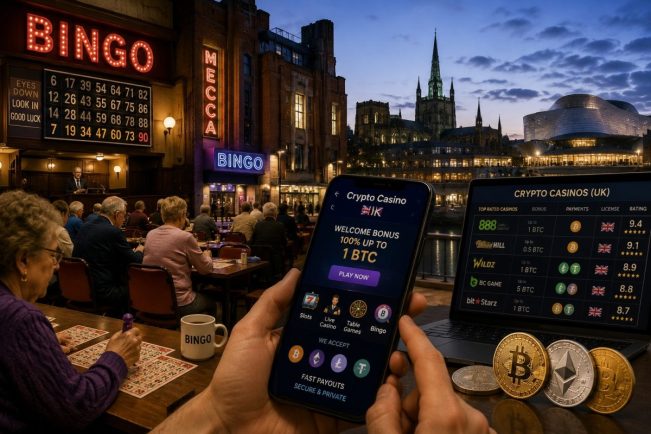
That move towards digital money is where things get genuinely interesting. As more residents grow comfortable holding Bitcoin and other digital coins, a whole category of online entertainment has grown up around it, and dedicated review sites now exist to make sense of it. Resources covering Crypto casinos (UK) rank the best operators available to British players, weighing up things like which coins are accepted, how quickly transactions clear, the strength of an operator’s licensing, the quality of welcome bonuses, and whether the games are independently verified as fair. Familiar names such as 888Casino and William Hill sit alongside newer crypto-first sites in these rankings. For a Coventry adult curious about where digital currency meets online play, that kind of plain comparison is a useful starting point.
The bingo years and what they meant
To understand the change, it helps to remember just how central the bingo hall once was. The British version of the game, with its ninety numbers and distinctive calls, became a national pastime after the Second World War, and Coventry embraced it with enthusiasm. Halls converted from old cinemas filled night after night, offering warmth, company and a modest thrill for the price of a book of tickets.
The appeal was never really about winning big. It was about belonging. The British version of bingo) thrived because it gave people a reason to leave the house and share a table with others. In a working city like Coventry, where shift patterns shaped daily life, those evenings offered a dependable rhythm — somewhere to unwind that asked very little and gave a sense of community in return.
A city used to reinvention
Coventry has rarely been a place that clings to the past for its own sake. Records of social history from 1700 show a settlement constantly remaking itself, from the ribbon-weaving trade to the watchmakers, then on to bicycles and the motor industry that defined the twentieth century. Each wave brought new workers, new wages and new ways to spend leisure hours.
That habit of reinvention matters here. A city accustomed to retooling its factories was never going to keep its entertainment frozen in amber. When the bowling alleys, the bingo halls and the working men’s clubs began to feel old-fashioned to younger adults, something else was always going to step in. The pattern is part of Coventry’s DNA: the way people relax follows the way they live and work.
The pull of the screen
The arrival of broadband, then smartphones, changed the calculation entirely. Why travel across town on a wet evening when the same flicker of anticipation could be found from the sofa? Online leisure offered convenience the old halls simply could not match, and Coventry’s adults adopted it as readily as anyone.
Bingo itself proved surprisingly nimble in making the jump. Far from dying out, it found a fresh crowd online and in revamped venues. As one account of how the game gets reinvented noted, operators dressed it up with music, lights and a livelier atmosphere to pull in adults who would never have set foot in a traditional hall. It is a reminder that the underlying appeal — luck, sociability, a shared moment — survives even as the packaging changes completely.
When money itself went digital
The latest chapter is about the money rather than the game. Across Warwickshire, contactless payments long ago became second nature, and a growing number of residents have taken the next step into digital wallets and cryptocurrency. Paying with a tap once felt futuristic; now holding a fraction of a Bitcoin barely raises an eyebrow among the more tech-minded.
That comfort with digital coins has naturally spilled into how some people enjoy online entertainment. Where a coin of change once bought a bingo book, a digital coin can now move almost instantly between accounts. The same instinct that drew earlier generations to a Friday-night flutter still exists; it has simply found a new currency and a new screen to live on.
What has stayed the same
For all the technology, the human core of it has barely moved. People still want a small dose of excitement, a break from routine and the gentle suspense of not knowing how a moment will turn out. The bingo caller has been replaced by an algorithm, and the dabber pen by a touchscreen, but the underlying itch is identical.
What has changed is choice. A Coventry adult today can pick from a vast spread of options, weighing convenience, cost and trust in a way the old halls never demanded. The smart move, as ever, is to treat it as leisure: a bit of fun for those who fancy it, enjoyed in moderation, much as the city has always enjoyed its downtime.