ROMANIA has plenty to offer the adventurous traveller, and northeastern Romania in particular, accessible directly from Birmingham Airport for as little as £12 one way with Wizz Air, contains some of the most quietly extraordinary landscapes and cultural heritage in the whole of Europe, almost entirely free of the crowds that have overwhelmed better-known destinations.
The flight to Suceava takes just over three hours. The airport is small, modern and easy to navigate, with taxis and car hire available immediately outside. Within twenty minutes you can be in the city centre, and within an hour you can be standing in front of frescoes that have survived five centuries of Carpathian winters without losing their colour.
Before booking, it is worth knowing that UK air passenger rights legislation may entitle you to compensation if your flight is significantly delayed. Using a flight delay compensation calculator from AirHelp is the quickest way to understand what you might be owed before or after travel.
Those wondering about the broader state of aviation costs and what they mean for low-cost fares should read the Coventry Observer’s recent piece on jet fuel and travel plans, which sets out the current situation clearly and is worth a look before committing to any booking.
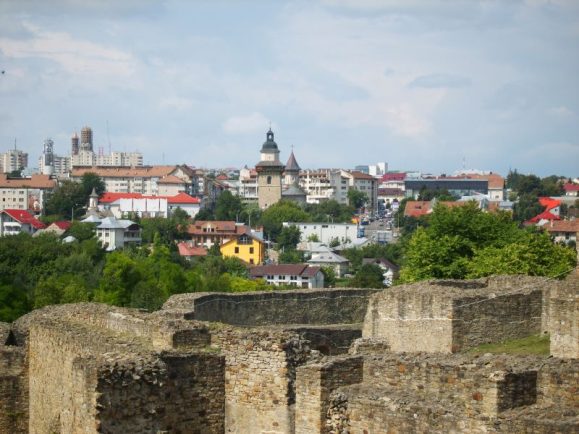
Suceava itself rewards a day of exploration before venturing further into the region. The city was once the capital of the Principality of Moldavia, a medieval state that controlled much of northeastern Romania for nearly two centuries, and the traces of that history are still visible. The fourteenth-century citadel sits on a hill above the city and offers sweeping views over the surrounding countryside. The Monastery of Saint John the New, a UNESCO World Heritage Site, stands in the city centre and is one of the most significant Orthodox religious sites in Romania. The open-air Bucovina Village Museum, on the outskirts of the city, preserves a collection of traditional wooden houses and craftwork that gives a vivid sense of how rural life in the region looked before industrialisation.
The real reason to come to Suceava, however, is the Bucovina region that surrounds it and specifically its painted monasteries. Built in the fifteenth and sixteenth centuries under the patronage of Moldavian princes, these Orthodox churches are covered from exterior wall to exterior wall in elaborate frescoes depicting biblical scenes, saints, battles and the Last Judgement. The colours, deep blues, warm ochres, earthy reds, have endured for five hundred years exposed to the elements, and remain vivid enough to stop visitors in their tracks. There is nothing else quite like them anywhere in Europe.
The four monasteries most visited from Suceava are Voroneț, Humor, Moldovița and Sucevița, all of them UNESCO-listed. Voroneț is often called the Sistine Chapel of the East, a comparison that sounds hyperbolic until you stand in front of its western wall and see the scale and detail of the Last Judgement scene painted across it. Humor, tucked into a wooded valley near the town of Gura Humorului, has an intimacy and warmth that many visitors find more affecting than the grander sites. Moldovița, further west, sits within a fortified enclosure and contains one of the best-preserved interior frescoes of any of the monasteries. Sucevița, the largest and most remote of the four, is ringed by defensive towers and set against a backdrop of forested hills that looks almost unchanged from the medieval period.
All four can be covered in a single long day by car, following a circular route of around two hundred kilometres through rural Bucovina. The roads wind through forested valleys and villages where horse-drawn carts still share the road with modern traffic, and the landscape itself (rolling green hills, tidy farmsteads, occasional views of the Carpathian ridge) is part of the experience. Organised day tours are widely available from Suceava and offer English-speaking guides whose knowledge of the history and iconography of the monasteries adds considerably to the visit.
For those with an extra day, the region has more to offer beyond the main monastery circuit. The salt mine at Cacica, around forty kilometres from Suceava, contains a Roman Catholic chapel carved entirely from salt and a subterranean lake that draws visitors year-round. The town of Gura Humorului, midway between Suceava and the western monasteries, makes a pleasant base and has a relaxed café culture that reflects the area’s mixed Romanian, Ukrainian and Polish heritage. Further into the Carpathian foothills, the roads become more dramatic and the villages more isolated, and travellers who push on into the mountains will find landscapes that feel genuinely remote by European standards.
The practical case for the trip is straightforward. Romania’s cost of living remains substantially lower than Western Europe’s, and the difference is immediately noticeable for visitors. A lunch of traditional Moldavian food (ciorbă, a sour soup that is the staple of the local diet, grilled meats, polenta) will cost a fraction of what an equivalent meal would cost in Coventry. Accommodation in Suceava ranges from guesthouses to modern hotels at prices that feel remarkable by UK standards. Car hire, which makes the monastery circuit considerably more flexible, is also inexpensive by comparison.
The best time to visit is late spring or early autumn. May and June bring long days, mild temperatures and the monasteries at their most photogenic; the exteriors are best appreciated in clear morning light, when the colours of the frescoes are at their most saturated. September combines good weather with the beginnings of autumn colour in the Carpathian forests, which adds a further dimension to the landscape when driving between sites.
Bucovina is rural, peaceful and largely untouched by mass tourism. The monasteries are among the great cultural monuments of the continent. And from Birmingham, the flight is shorter than the drive to London.