
It’s a small piece of the checkout page, but it now carries more weight than many sale banners. First-order discounts, member pricing, app-only codes, and delivery perks are being used to pull shoppers across the line at the exact moment they are reviewing the final price.
The timing is what shows importance. With grocery and household costs still shaping spending habits, shoppers are not just looking for summer shopping deals. They are judging how fast those deals appear, how clearly they apply, and whether the reward is worth another account in an already crowded inbox.
The Checkout Prompt Has Become a Value Test
Retailers know the hesitation point. Most shoppers will have already chosen the item, made peace with the price, and reached the last screen. Then, a clean sign-up offer can soften the landing… But a clumsy one can send the whole basket back into doubt.
The strongest sign-up bonuses make the next action obvious. Create the account, receive the code, see the revised total. That is the bargain; that’s what we strive for. When the reward is delayed, vague, or attached to exclusions, however, the offer starts to feel like another chore at checkout.
Epsilon reported in 2025 that more than half of surveyed consumers sign up for a loyalty program when the opportunity appears, yet 65% would leave if the rewards are not worth it.
The exchange still works when the value is visible! People will trade an email address for savings, but they are less willing to pretend a weak perk is a relationship.
The Perks Shoppers Are Chasing This Summer
The perks getting attention this summer are those that tend to solve a problem shoppers can see. Delivery feels too high; the first basket needs a nudge; a later purchase feels easier to justify when the current one earns something back.
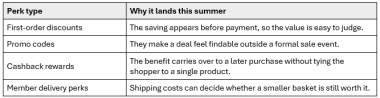
Retailers can make these perks sound new, but the winning versions are usually plain and simple:
Promo codes still draw attention because they create a sense of control around price, but Cashback rewards have a different pull. Retail Insider reported in June that cashback was the most popular reward option among Canadian program participants in a recent survey.
The return may be modest, but the psychology is clear: the spend gives something back.
Simple Rewards Are Beating Clever Ones
Some brands still build reward systems as if complexity equals depth. Tiers, unlocks, bonus windows, expiry rules. The committed customer may follow along, yet the casual summer shopper is usually more stubborn.
A cleaner offer travels further in current times. Ten dollars off a first order has less theatre than a multi-stage reward ladder, but it does its job before doubt creeps in, while free delivery can matter more than a larger future perk because it removes a cost the shopper already dislikes.
A loyalty program has to show its value while the decision is still alive, not weeks later when the welcome email has disappeared beneath receipts.
The old promise was future access, yes, but the sharper one is immediate relief.
The Perk Hunt Has Moved Beyond Traditional Retail
Sign-up offers now stretch past familiar retail categories. The same value check appears around travel clubs, subscription trials, and digital entertainment.
The category changes, but the consumer question barely moves: what is the upfront benefit, and how much effort does it take to claim?
That comparison habit is especially clear in markets where offers are reviewed before a customer commits. A shopper looking at seasonal subscriptions or entertainment accounts may scan the welcome value before thinking about the brand in any deeper way. In that context, the SpinAway Casino Canada bonus sits within a broader sign-up economy, where customers judge whether the opening perk is clear, timely, and proportionate to registration.
Where Perk Fatigue Starts to Show
Every sign-up carries a second transaction. The shopper receives a discount, points, cashback, or access. The brand receives a cleaner line into behaviour: what was browsed, abandoned, and revisited after the first saving.
Most shoppers understand that exchange, even if they do not describe it in those terms. The discomfort appears when the ask feels larger than the reward. A newsletter box is one thing. A long registration flow before the discount is visible is another.
There is also a ceiling to how many programs a household can actively manage. Eventually, the best offers are the ones that hold up after the first order, when the customer finds out whether the perk was useful or just a one-time discount with a crowded inbox attached.
The small box above the checkout button is working harder now. It is a discount, a data request, and a trust test in one cramped space. Shoppers are still chasing perks this summer, but they’re also getting quicker at spotting which ones deserve the click.
Article written by Dave Mannion