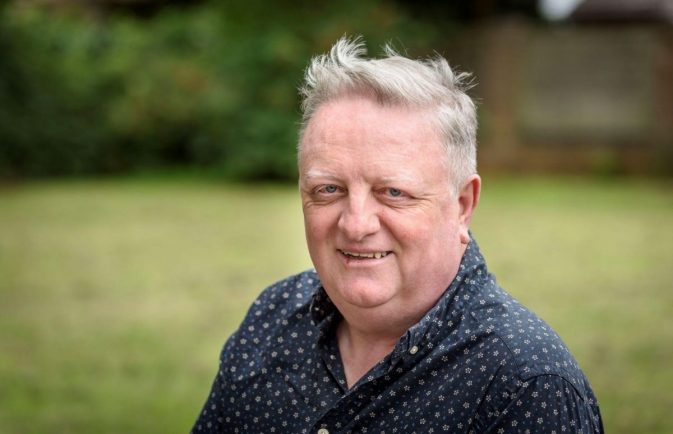
A COVENTRY cancer survivor, whose body was riddled with tumours “like a target sprayed with machine gun fire”, is launching a public appeal to help tackle the devastating loss of funding for cancer research, caused by the coronavirus outbreak.
Mark Routledge, who lives in Coventry with his wife Kathryn, says he owes his life to research after skin cancer left his body covered in tumours from his head to his heel. The 59-year-old construction project manager says he had “an amazing response” to immunotherapy treatment and is currently cancer free.
Mark, a dad-of-five who has recently become a great grandfather, has vowed to help Cancer Research UK continue its mission as it launches an urgent new appeal for donations to help get life-saving work back on track.
Following the cancellation of fundraising events like Race for Life, the charity is expecting a staggering £160 million drop in income in the year ahead. As a result, Cancer Research UK has had to make the difficult decision to cut £44 million in research funding, but this is likely to be just the beginning.
Mark’s heartfelt plea for public support for Cancer Research UK comes as the charity launches an urgent new TV appeal film which shows a cancer patient on the verge of finding out whether her treatment has been successful, when the video pauses at the critical moment.
As Mark owes his life to advances in treatment, he hopes his own story will highlight the threat the funding gap poses to future breakthroughs for cancer patients and hammer home the message – to save lives tomorrow, Cancer Research UK needs the public’s support today.
He was diagnosed with malignant melanoma in 2016 after a mole on his side became itchy. Mark’s GP sent him for a biopsy but the results were slow to arrive and Mark was lulled into a false sense of security.
“I went to the appointment on my own, and it was only when I walked in the room and saw the cancer nurse that I realised what was going on. It was a real shock,” said Mark.
Stunned by the news that he had skin cancer, Mark walked slowly home to let it sink in before telling his wife Kathryn. The couple went away for the weekend in their motorhome before deciding to be open about the diagnosis and tell the whole family.
Doctors initially tackled Mark’s cancer with surgery. The melanoma was removed and he had follow up scans to check for any spread. Towards the end of the year a scan showed that the cancer had spread to the lymph nodes under one arm.
Mark had further surgery to remove the lymph nodes and was again monitored with scans. Everything went well until September 2017, when a scan showed the cancer had spread again. He had his remaining lymph nodes removed just before Christmas, only being allowed out of hospital to spend Christmas Day at home.
In April 2018 Mark started to get lumps on his back and shoulders. Biopsies and full body scans brought the devastating news that the melanoma had spread to his bones and liver.
“I’d had so much surgery to remove the tumours it was like the game ‘Whack-a-Mole’. At one point I’d had two surgeons, one on each shoulder, chatting to me as they operated on my tumours while I was fully conscious. It was surreal,” said Mark.
“But it had reached the stage where they couldn’t do any more surgery because they knew it wasn’t working. It was a real low. At this stage I asked my oncologist what would happen if I didn’t receive any treatment? Her reply was three to six months and I would most probably die”.
“I had scans at that stage but I wasn’t shown them. It was only six months later when immunotherapy had worked its miracle that my consultant dared to show me the earlier scans. My body was riddled with tumours from my head right down to my Achilles heel. I looked like one of those body-shaped targets that had been sprayed with machine gun fire – hot spots everywhere you looked.
“They only showed me the earlier scan after I’d seen the clear scan because it was just too scary. Seeing that later scan was a magic moment – the tumours had just disappeared. My response to the immunotherapy had been amazing. My consultant said she could hardly believe it.”
But the immunotherapy treatment knocked Mark for six and began to adversely affect his other organs. It was too dangerous to continue with it. By November 2018 the cancer returned again in Mark’s groin.
“Thanks to research, I wasn’t out of options. The doctors talked to us about a new combined, targeted treatment using the drugs tafinlar and mekinist which could be taken in tablet form. It took a while for my body to get used to it, but despite spending New Year to February 2019 in and out of hospital with suspected sepsis amongst other things, I have responded really well,” said Mark.
Last summer Mark’s wife Kathryn took part in Cancer Research UK’s Race for Life Coventry with friends in celebration of his survival.
Mark’s latest scans have shown no evidence of cancer and he is tolerating his treatment well. His main side effect is fatigue but he is now back to working three and a half days a week and even enjoyed a proper holiday in Tenerife with Kathryn just before the Covid-19 crisis hit.
Mark is desperate to get his message about the importance of research across to the public. He said: “My experience means I understand the importance of Cancer Research UK’s work all too clearly. It’s entirely thanks to improved treatments that I’m alive today – so it upsets me to think about research being held up and what this might mean for people affected by cancer in the future.
“By boosting funding now, we can all help to lessen the future impact on patients. So, I hope that people in Coventry will be inspired by the charity’s determination to carry on beating cancer and give whatever they can. They could make a real difference to people like me.”
Cancer Research UK’s work into the prevention, diagnosis and treatment of cancer has been at the heart of progress that has seen survival in the UK double in the last 40 years.
Thanks to the generosity of its supporters, the charity currently funds around 50 per cent of all publicly funded cancer research in the UK.
However, as a direct result of the coronavirus pandemic, promising projects which could have the big answers to cancer are being held up.
Jane Redman, Cancer Research UK spokesperson for the West Midlands, said: “We’re grateful to Mark for helping to underline the stark reality of the current situation.
“COVID-19 put so much of our research on pause, leaving us facing a crisis where every day and every pound counts.
“With around 31,600 people diagnosed with cancer each year in the West Midlands*, we will never stop striving to create better treatments. But we can’t do it alone.
“Whether they donate, sign up to Race for Life at Home or shop at our stores – with the help of people in Coventry and beyond, we believe that together we will still beat cancer.”