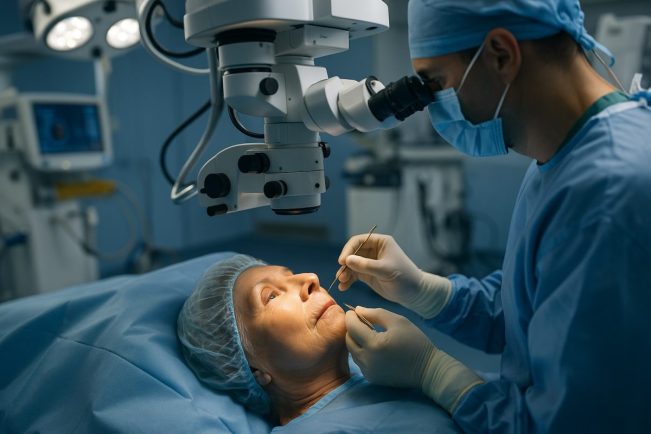
Blind patients can now read and recognise faces again thanks to a “revolutionary” bionic chip, in what experts are calling a “new era” for artificial vision.
The ultra-thin wireless implant, measuring just 2mm by 2mm, is inserted under the retina and connects to a video camera fitted on a pair of augmented-reality glasses.
Dozens of patients who had lost their eyesight through age-related macular degeneration (AMD) were fitted with the device in a trial that included Moorfields Eye Hospital in London. More than 80 per cent of participants saw major improvements in their vision.
Around 600,000 people in the UK are affected by AMD, a number expected to rise with an ageing population. The condition, which currently has no cure, can only be managed with regular injections that slow retinal damage.
The new system works by recording the scene in front of the patient through the glasses’ camera. Artificial intelligence then converts this information into an infrared signal, which is beamed to the implant. The chip stimulates undamaged inner retinal neurons, allowing them to transmit signals to the brain through the optic nerve, where they are interpreted as vision.
‘It was dead exciting when I began seeing a letter’
Sheila Irvine, one of the first patients in the trial, described how her life changed after the implant.
Before surgery, she lived with “two black discs” in front of her eyes, which prevented her from reading or driving. “I was an avid bookworm, and I wanted that back. I was nervous, excited, all those things,” she said.
“Initially, I couldn’t see it at all. It was like a big cloud on the page, it was all just white. But I thought to myself, ‘There’s writing on this page, I’m gonna bloody well see it and I’m gonna keep going until I do.’ And then one day I started to see edges and I thought, ‘Here we go, here we go.’
“It’s a new way of looking through your eyes, and it was dead exciting when I began seeing a letter.”
A ‘new era’ in artificial vision
In a healthy eye, light-sensitive cells in the retina capture light and convert it into electrical signals sent to the brain. In AMD, these cells are damaged, creating a black spot in central vision. Peripheral vision often remains, but the disease can progress to full sight loss through a process known as geographic atrophy (GA).
The recent clinical trial enrolled 38 patients across Britain, France, Germany, Italy and the Netherlands who were affected by GA. After a year of using the implant, most participants showed significant improvements in reading letters on a standard eye chart, with an average gain of 25.5 letters, or five lines, and one patient improving by as many as 59 letters, equivalent to 12 lines.
“These are elderly patients who were no longer able to read, write or recognise faces due to lost vision,” said Mahi Muqit, senior vitreoretinal consultant at Moorfields Eye Hospital and the Institute of Ophthalmology at UCL.
“They couldn’t even see the vision chart before. They’ve gone from being in darkness to being able to start using their vision again, and studies have shown that reading is one of the things patients with progressive vision loss miss most.
“In the history of artificial vision, this represents a new era. Blind patients are actually able to have meaningful central vision restoration, which has never been done before.”
The chip insertion procedure takes just a couple of hours and is activated a month later. Patients then spend several months learning how to see again using the device, which also includes a “zoom-in” function to magnify letters.
From lab to life
The implant, known as the Prima system, was developed by Science Corporation, a Californian biotech company specialising in neural engineering.
“This breakthrough underscores our commitment to pioneering technologies that provide hope to patients in need, and which have the ability to transform lives,” said Max Hodak, co-founder and chief executive of Science Corporation.
“We are excited about the potential of Prima to redefine vision restoration for these patients.”
The company is now working to secure regulatory approval for the device and hopes the technology could eventually be offered on the NHS.
Experts estimate that around one in four people who are legally blind in the UK have geographic atrophy caused by AMD.
“This study confirms that, for the first time, we can restore functional central vision in patients blinded by geographic atrophy,” said Dr Frank Holz, lead author of the study, which was published in the New England Journal of Medicine. “The implant represents a paradigm shift in treating late-stage AMD.”
Main Image: For illustration purposes only.