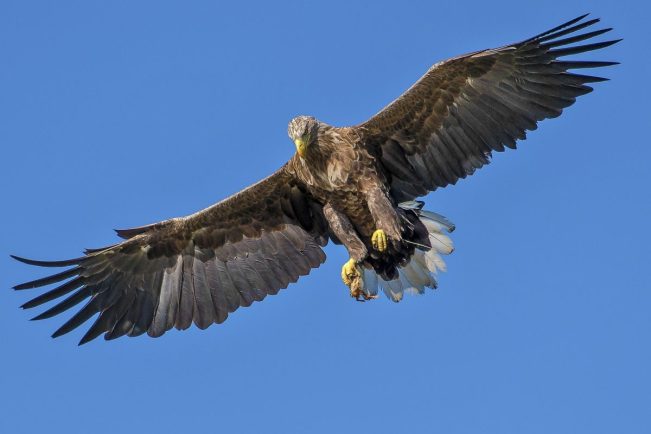
Golden eagles could soon soar once more over England’s uplands, in what ministers are hailing as a dramatic return of one of Britain’s most iconic birds of prey.
The majestic raptors, once a familiar sight across the country and referenced more than 40 times in Shakespeare’s works, have been largely absent from English skies for more than a century. Now, a £1 million Government-backed scheme aims to bring them back.
With wingspans stretching up to eight feet, golden eagles are among the largest birds of prey in Britain, second only to the white-tailed eagle. Their striking brown feathers, tinged with gold around the neck, make them unmistakable, yet they are rarely seen due to their preference for remote, undisturbed habitats.
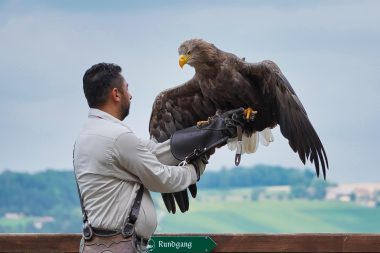 Golden Eagles have been largely absent from English skies for more than a century. Image by Anrita from Pixabay
A new study by Forestry England has identified eight potential reintroduction sites, most of them in northern England, where conditions are suitable to support thriving populations once again.
Under the plans, young eagles aged between six and eight weeks could be released into the wild as early as next year, marking a significant step in efforts to restore the species.
Emma Reynolds, the Environment Secretary, said:
“This government is committed to protecting and restoring our most threatened native wildlife, and that includes bringing back iconic species like the golden eagle.
“We will work alongside partners and communities to make the golden eagle a feature of English landscapes once again.”
Golden eagles were driven to extinction in England and Wales by around 1850, after being relentlessly persecuted during the Victorian era. Landowners, shepherds and gamekeepers saw them as a threat to livestock and game birds, leading to their widespread eradication.
While small numbers managed to cling on in the remote Scottish Highlands, their presence in England has been fleeting at best. Only a handful of pairs have been recorded over the past 150 years, and the last known eagle in England died in the Lake District in 2016.
These powerful predators typically feed on small mammals and birds, including hares and red grouse. They favour nesting on cliffs or in tall trees in rugged, mountainous terrain, far from human disturbance.
There was a brief recovery in their numbers during the 1940s and 1950s, but this proved short-lived, with populations declining once again in the decades that followed.
More recently, however, conservation efforts in Scotland have offered a glimmer of hope. The South of Scotland Golden Eagle Project, launched in 2018, relocated birds from the Highlands to the Moffat Hills in a bid to boost numbers.
The results have been striking. The population in southern Scotland has now reached nearly 50, the highest level recorded in centuries. Satellite tracking has also revealed that some of these birds have already begun venturing south, crossing the border into northern England.
The new initiative, led by the charity Restoring Upland Nature (RUN), aims to build on that success by supporting further reintroductions south of the border.
Experts believe golden eagles from Scotland could become a more regular sight in northern England within the next decade, although establishing breeding populations is expected to take longer.
Alan Fielding, a conservation biologist involved in the Scottish project, stressed the importance of working closely with farmers and local communities.
He said cooperation would be key to ensuring public support, adding that the birds could also bring economic benefits by attracting wildlife tourism, as seen in Moffat where birdwatchers have flocked to catch a glimpse of the returning eagles.
The plans form part of the Government’s wider environmental strategy to halt the decline in species abundance by 2030.
Dr Cat Barlow, chief executive of RUN, said:
“This presents a truly exciting and potentially game-changing moment for the return of golden eagles to England.
“Our priority will be to listen, to work in partnership, and to ensure that golden eagle recovery supports both nature and the people who manage these landscapes, so that everyone can enjoy the thrill of seeing golden eagles flying high once again across the uplands of the UK.”