
There is a version of university life that looks great in prospectus photos. Smiling students on green campuses, laptops open in sunlit libraries, everyone apparently thriving. Then there is the actual version: the 2 a.m. panic before a deadline, the skipped meals, the slow erosion of sleep that starts in October and does not really stop until summer. Most students know the second version far better than the first.
Balancing student well-being in university with genuine academic performance is one of the harder things a young person is ever asked to do, and almost nobody explicitly teaches them how. This article is an attempt to be honest about that.
Why the Standard Advice Keeps Failing Students
The internet is full of productivity tips aimed at students. Drink more water. Use a planner. Take breaks. Sleep eight hours. None of it is wrong exactly. But most of it treats the symptoms without touching the actual structure of the problem.
University is not just difficult in terms of workload. It is socially disorienting, financially stressful, and identity shaping all at once. A first year student at the University of Edinburgh or Ohio State is not simply managing tasks. They are figuring out who they are, away from home, often for the first time, while simultaneously being evaluated on academic performance. That context matters.
A 2022 report from the American College Health Association found that over 60 percent of students reported feeling overwhelming anxiety at some point during the academic year. Separate research from the University of Michigan identified poor sleep as the strongest single predictor of academic difficulty, ahead of workload, financial strain, or social isolation. These are not fringe findings. They reflect something structural about how universities operate.
When a student turns to an essay writing help when deadlines hit during a particularly brutal semester, it is rarely laziness driving that decision. It is often a person who has run out of capacity and is trying not to collapse entirely. Understanding that distinction matters when thinking about student support.
What Work Life Balance Actually Looks Like for a Student
Work life balance for students is a phrase borrowed from corporate wellness culture and applied as though the situations are comparable. They are not. A 45 year old professional can set boundaries with their employer. A 19 year old does not set boundaries with their degree program. The power dynamic is entirely different.
What balance actually looks like for students is less about equal distribution of time and more about protecting recovery. The body and mind need periods of genuine rest to consolidate learning, regulate emotion, and maintain motivation. Without that recovery, academic performance does not just plateau. It actively deteriorates. Many students who struggle to manage heavy workloads eventually turn to research proposal writing services for academic guidance and structural support. When used responsibly, research proposal writing services can also help students reduce stress and focus more effectively on maintaining a healthier study-life balance.
High performers who are quietly struggling often do not seek out a KingEssays writing service or any other form of support because they have convinced themselves they should be able to manage alone. That self imposed isolation tends to be more damaging than the original stressor. Recognizing the need for help early is itself a skill, and a genuinely useful one.
A few things that tend to make a measurable difference:
Anchoring one fixed rest period per day. Not scrolling, not passive TV, but something that genuinely disengages the mind. A walk, reading fiction, cooking something from scratch. Students who protect even 45 minutes of this daily tend to report substantially lower stress levels than those who try to optimize every hour.
Treating sleep as a study tool, not a luxury. Matthew Walker, sleep scientist and author of “Why We Sleep,” has argued extensively that memory consolidation during sleep is not optional for learning. Students who cut sleep to study more are often trading long term retention for short term cramming. The return on that trade is poor.
Being selective about commitments rather than exhausted by all of them. Joining every society, attending every social event, volunteering, part time work, full academic load. Something in that list has to give. The students who navigate university best tend to be those who make deliberate choices rather than default ones.
The Mental Health Dimension Nobody Wants to Sit With
Tips for university mental health tend to focus on resources: counseling services, helplines, apps. These are valuable. But there is a prior question that gets skipped: how do students recognize that they need support before they are already in crisis?
Burnout does not announce itself. It builds slowly through accumulated small depletions. A student stops enjoying subjects they previously found interesting. Social contact begins to feel like effort rather than relief. Concentration shortens. Minor setbacks feel disproportionately significant.
The World Health Organization formally recognized burnout as an occupational phenomenon in 2019. While that classification was aimed at workers, the psychology maps directly onto students. Exhaustion, cynicism toward one’s responsibilities, and reduced sense of achievement are the three markers. A student experiencing all three is not being dramatic. They are experiencing a recognized pattern that, without intervention, tends to worsen.
Universities like the University of Toronto and King’s College London have expanded embedded mental health support within academic faculties rather than centralizing it in a single counseling office. Early evidence suggests that making support proximate to where students actually are, rather than requiring a separate appointment at a separate building, increases uptake significantly.
A Practical Framework, Not a Prescription
Rather than a list of rules, what seems to work across different student types is a loose framework built around three questions asked weekly:
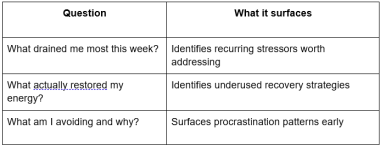
This is not journaling for the sake of journaling. It is a diagnostic. Five minutes on a Sunday evening answering those three questions produces more useful information about how to adjust the coming week than most productivity systems.
The Longer View on Avoiding Burnout in College
How to avoid burnout in college is a question that tends to get answered with tactics. But burnout is ultimately a values problem as much as a time management problem. Students burn out when they are spending most of their energy on things that do not align with any internal sense of meaning.
That is hard to address with a scheduling app.
The students who seem to come through university with the most intact sense of themselves are not necessarily the ones with the best grades or the most efficient systems. They are the ones who stayed curious, maintained at least one or two relationships that had nothing to do with academic performance, and kept some version of a private inner life that the degree program could not reach.
That sounds abstract. It is not. It means having a conversation with someone that has nothing to do with coursework. It means reading something nobody assigned. It means occasionally doing something badly, or slowly, or just for the experience of it.
How to manage stress in college, in the long run, comes down to whether a student is building a life or just building a transcript. The healthiest students are almost always doing some version of both.
What Universities Still Need to Address
Students are not the only ones with work to do here. The institutional design of higher education creates many of the conditions that produce poor well-being outcomes. Compressed assessment periods, lecture schedules that ignore chronobiology, inadequate mental health staffing ratios, and cultures that implicitly reward overwork all play a role.
Institutions like Stanford and the London School of Economics have begun piloting flexible assessment pathways and mandatory wellness weeks. These are steps. They are not yet solutions. Until the structural pressures are addressed at the system level, individual strategies for student well-being in university will always be working against a headwind.
That does not make individual strategies worthless. It just means students deserve honesty about the environment they are navigating, rather than advice that implies the difficulty is mostly a personal management failure.
It is not.
Written by EsayPay service by
David Kirby