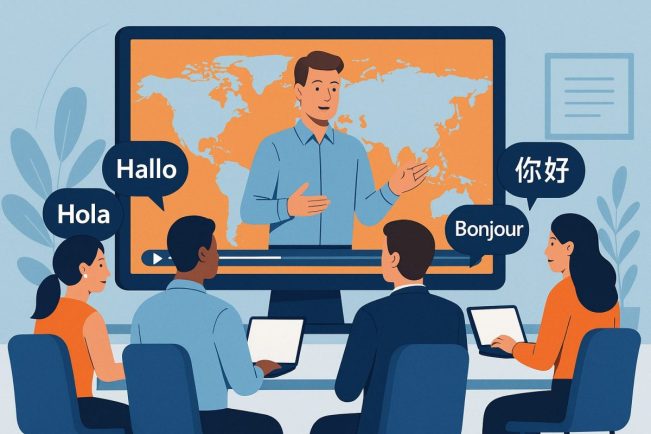
Training videos are vital tools for businesses that need to deliver clear, consistent guidance to teams around the world.
As companies scale across regions, maintaining quality and clarity in communication becomes a challenge.
Visual materials must not only convey the right information but also feel local, relevant, and accessible.
When content remains in a single language, understanding drops and outcomes vary. Standard subtitles may not provide the full clarity that teams need to succeed. If learners feel disconnected from the material, engagement falls, and adoption suffers. This is especially true when training relies heavily on spoken instructions, technical guidance, or scenario-based storytelling.
Companies aiming for effective global training need to think beyond translation. Cultural cues, tone, pacing, and visual elements all influence how information is received. Getting these details right can transform a single training video into a valuable asset across multiple countries and departments.
Why Some Training Videos Struggle Globally
Many training videos fail in global contexts due to language mismatches. A video made for English-speaking teams may not make sense to viewers in other regions, even if subtitles are added. Some terms do not translate well, while humour or examples based on one culture can create confusion or distraction in another.
To overcome this, companies are turning to tools that allow direct localisation of the spoken message. Instead of relying solely on text overlays, some now implement voice-based solutions that make the content sound native to each audience. An AI voiceover system helps companies recreate the original message in another language while preserving tone and clarity.
This approach improves clarity and accessibility without the need to re-record entire videos. It also supports consistency, allowing all teams to receive the same instructions in their native language. AI-generated audio tracks save time, reduce production complexity, and increase the value of existing training materials.
Building Multilingual Training That Connects
Creating global-ready videos requires a foundation that supports easy adaptation. It starts with scriptwriting that avoids idioms, local slang, and overly complex sentence structures. Clear, concise language works best for translation, and it improves the flow of automated or voice-cloned dubbing.
Pacing is also important. Adding short pauses after key points gives room for languages that require more words or slower delivery. These pauses also help teams absorb the material without feeling overwhelmed. When spoken content feels natural and unhurried, learners are more likely to stay focused.
Visuals should be designed with flexibility in mind. Avoiding text-heavy graphics and using universal symbols makes adaptation easier. Simple changes like using icons instead of text labels, or replacing culturally specific gestures with neutral ones, improve comprehension across diverse regions.
Technical Considerations for Smooth Delivery
The technical setup behind a training video can influence how widely and effectively it is used. Choosing a video format that works across devices and networks is essential. Compressing video files helps ensure smooth playback, especially in areas with limited internet access or older hardware.
Captions and transcripts enhance accessibility for those who prefer to read along or need visual support. Providing downloadable resources alongside video content helps reinforce learning and allows for offline study. This is particularly helpful in remote or field-based roles.
Consistent technical standards across all videos simplify localisation and reuse. Establishing clear specifications for file size, aspect ratio, and audio format supports smoother integration with AI tools and content platforms. Having a standardised format helps teams avoid delays and errors during production.
Cultural Adaptation Beyond Language
Translation alone is rarely enough to make content feel local. The context of examples, the appearance of characters, and even colour choices can affect how messages are received. What works well in one region may confuse or offend in another, so careful attention is required.
Adjusting content to match local work styles or social expectations increases its relevance. This might include changing dialogue delivery to be more formal or more relaxed, depending on the market. Small changes in delivery can create a much stronger connection with the viewer.
Even wardrobe, background settings, or voice tone can influence how authentic the training feels. For example, a video set in a formal office may feel out of place in a region where teamwork often happens in informal environments. Reviewing content with local input helps address these subtle, but important, differences.
Creating a Scalable Localisation Workflow
To streamline multilingual training, businesses benefit from creating modular content. Breaking training into short, interchangeable sections allows faster updates and easier translation. This approach supports long-term maintenance and reduces the cost of future changes.
A central library of approved content and templates helps maintain consistency across teams. Cloud-based systems allow regional staff to access materials, track progress, and offer feedback. This reduces duplication and improves control over branding and quality.
Successful global training systems include naming conventions, translation checklists, and approval workflows. When every team follows the same process, production becomes more predictable and efficient. Shared tools also promote collaboration between teams in different countries or time zones.
Improving Speed with AI and Automation
Many companies are now integrating automation into the localisation process. AI dubbing, real-time subtitle generation, and cloud-based editing platforms allow faster turnaround. These systems let global teams contribute to content production without needing to meet in person.
Modern AI dubbing tools preserve the voice and emotion of the original speaker while converting the language. This creates a more seamless viewer experience, improving learning outcomes and audience trust. Learners hear the content as if it were created for them, not simply translated.
By combining automated draft generation with local human review, companies can produce tailored content in a fraction of the time. These tools allow updates to roll out quickly, helping businesses respond to product changes, policy updates, or new onboarding requirements without delay.
Make Your Training Go Further
Multilingual video content is now a business necessity, not a luxury. With the right tools and planning, companies can deliver clear, culturally relevant training to every team, no matter where they are based. From AI voiceover tools to cloud-based collaboration, technology makes localisation faster, smarter, and more impactful.