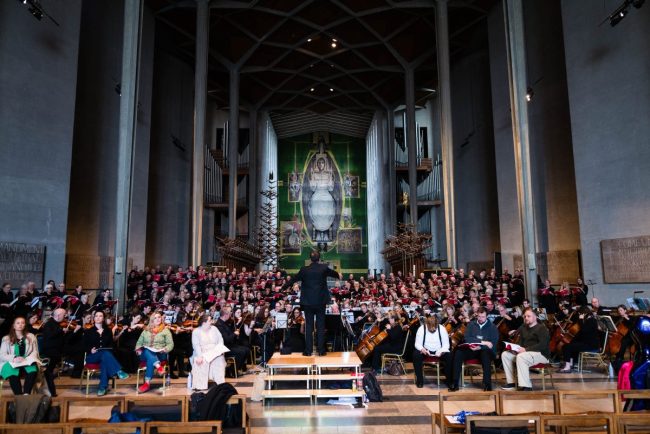
SUCH was the sheer abundance of musical resources on display for this concert, there was barely room to shoehorn in a packed audience.
The piece being performed was huge in every sense and the cavernous setting of Coventry Cathedral was more than a match.
Mahler’s monumental Eighth Symphony has, ever since its appearance in 1910, stood as one of the towering peaks of musical mountaineering. Spread over two parts it fuses symphonic music at its most potent with soaring choral lines and a full rank of virtuosic soloists all uniting under a broad theme of love and redemption. Forever known as the symphony of a thousand this is music at its unashamedly biggest.
Leamington Sinfonia at full-strength under Joe Davies tackled the full dynamic range Mahler brings to all his orchestral music. Eight soloists added their lung power.
The massed ranks of choral groups brought together read as if someone has pulled the Choir section from the Yellow Pages and just ordered the lot.
Coventry Cathedral Chorus and Choir, Daventry Choral Society, Divertimento, Royal Leamington Spa Bach Choir, Spires Philharmonic Chorus, Warwick and Kenilworth Choral Society and Warwickshire Youth Choirs – it was a spectacular sight and a formidable vocal power to be facing.
No matter how great a number of performers there may be, each listener still only has two ears and success at something on this scale depends heavily on two vital aspects – balance and clarity. In both cases the evening proved generally convincing but with a few notable qualms.
The Cathedral’s vast reverb must be the bane of many a musician, and indeed anyone trying to address the far spaces of the nave with any hope of being understood. At times the slow decay of one phrase lingered long after the arrival of the next making for an unwelcome muddiness, conquered during the piece’s full-on sections but making other parts sound woolly.
Balance is also essential in this piece and just about impossible to achieve when the distances between musicians and the variety of distances out to the listeners are considered. No two people are likely to have heard exactly the same thing.
Generally the orchestra and choirs matched each other but not so the soloists. The higher vocal ranges cut through well but some of the lower registers were simply swamped. This was in no way a fault of the singers themselves whose lung-busting, vein-popping effort was painfully clear to see.
Placing one soloist in the pulpit behind everyone will probably have been more of a success one one side of the centre aisle than the other; likewise the placing of a brass section against one side wall. Sadly the children’s choir all-but disappeared.
What did come through though was the undeniable, unstoppable joy of music-making that underpinned the whole project. Committed and concentrated throughout this was a real tour de force for all involved.
The closing ten minutes when the bombast gives way to poignant and gentle reflection and the texture becomes as fluid as Mahler at his romantic best, were quite gorgeous and genuinely moving, leading the way to a triumphant statement ending.
This was conductor Joe Davies’s final outing with the orchestra he has done so much to shape in recent years. Despite the technical drawbacks this was another success, as ambitious as it was impressive and the orchestra must work to ensure this upward climb doesn’t end here.
Matthew Salisbury