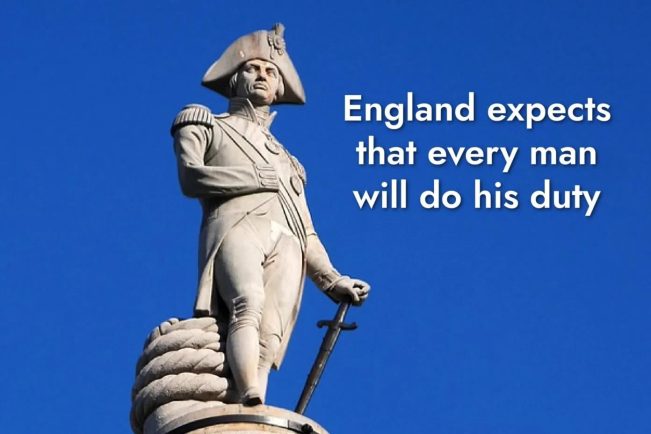
Today, the nation proudly celebrates Trafalgar Day – a day etched into the annals of British history as a testament to our unrelenting naval prowess and leadership.
Every October 21st, we remember the extraordinary events of 1805, when Britain delivered a resounding blow to the combined forces of France and Spain in the legendary Battle of Trafalgar.
Fought off the Cape of Trafalgar, near Cadiz in Spain, this decisive naval engagement not only thwarted Napoleon’s ambitions but also solidified Britain’s undisputed mastery of the seas.
At the heart of this triumph was the indomitable Lord Horatio Nelson, one of the most revered figures in our history. Despite being war-wounded – having lost an arm and the sight in one eye – Nelson’s bravery, strategic genius, and unwavering leadership guided the British fleet to an awe-inspiring victory. As Admiral, Nelson was beloved by his men, earning their loyalty through his care and commitment to their well-being, a trait that set him apart from other leaders of the time.
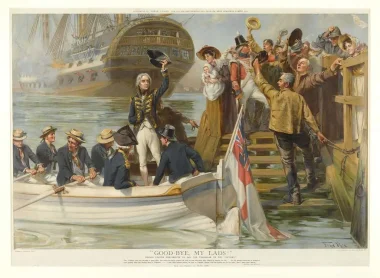 ‘Good-Bye My Lads!’ Nelson leaving Portsmouth to sail for Trafalgar on the Victory. Source: Royal Museums Greenwich. Copyright info – Public Domain
Nelson’s legacy had already been firmly established before Trafalgar, with stunning victories in Egypt, the Caribbean, and Denmark, but it was this battle that immortalised him as a national hero. As Napoleon Bonaparte’s conquests swept across Europe, fear gripped the British Isles. An invasion seemed inevitable. The French Emperor, having already overrun much of the continent, had set his sights on Britain. But Nelson, unflinching in the face of danger, stepped forward to lead our brave sailors against the impending threat.
On that fateful day, 27 British ships of the line, accompanied by four frigates, squared off against a larger force of 33 French and Spanish ships and their seven frigates. However, size was no match for the sheer discipline, experience, and mastery of the British fleet. While the French and Spanish forces had been weakened by the fallout of the French Revolution, which saw many of their finest officers either executed or dismissed, the British Navy was primed and ready.
In a brilliant tactical manoeuvre, the British used their four frigates to lure the enemy ships out of Cadiz harbour. These nimble vessels kept a watchful eye while the bulk of Nelson’s forces held back, poised for the decisive strike. By mid-October, Nelson had consolidated his fleet, which now stood at full strength, while the French commander, Vice-Admiral Pierre-Charles Villeneuve, struggled with a lack of men and supplies.
Villeneuve may have glimpsed hope when Nelson was forced to send some of his ships for resupply in Gibraltar, but the British remained undeterred. As the two lines of British ships, led by Nelson and Admiral Collingwood, surged forward to engage the French and Spanish fleets, history was made. Nelson, aboard the HMS Victory, was at the forefront, in the thick of the action. Tragically, a French sniper’s bullet struck him down, but not before the tide of battle had firmly turned in Britain’s favour.
Nelson’s final moments were spent below deck, knowing that his fleet had triumphed. His last words remain the subject of debate – “Kiss me, Hardy” or perhaps “Kismet, Hardy” – but what is certain is that his friendship with Captain Hardy and his undying devotion to his country defined his final breath. While Spain too lost its admiral shortly after the battle, the British victory was absolute.
The news of Trafalgar’s victory sparked an outpouring of national joy. Church bells rang out across the land, theatre performances were dedicated to the triumph, and every corner of the nation celebrated this glorious achievement. It was a victory that not only ensured Britain’s safety but also marked the dawn of a new era in which Britain ruled the waves and wielded unparalleled influence in Europe.
Yet amid the jubilation, there was a profound sense of loss. Nelson, the hero of the hour, had fallen. Trafalgar Day is as much about commemorating his life and leadership as it is about celebrating the victory. His death cast a shadow over the triumph, but his spirit lives on, immortalised in the hearts of the British people.
Today, Trafalgar Square becomes the centrepiece of these celebrations, with the Sea Cadet Corps proudly leading the annual Trafalgar Day Parade. In a fitting tribute to Nelson and his sailors, these young cadets, steeped in the traditions of the Royal Navy, hoist the Naval flag high as the nation remembers its greatest naval victory. And for those wishing to relive the glory, HMS Victory herself can be visited year-round at the Portsmouth Historic Dockyard, a living relic of Britain’s naval supremacy.
As we celebrate Trafalgar Day today, let us not forget the courage, brilliance, and sacrifice of those who fought to preserve the freedoms and supremacy of our great nation. Britain’s maritime dominance was born from battles like these, and today, we salute the men who made it possible.
Long may we remember, and long may we reign supreme on the seas!
HISTORIAN’S NOTE: We stand today, two centuries on, in awe of Nelson’s daring, his courage, and his vision
Two hundred and twenty years ago today, the great Admiral Nelson made decisions that not only sealed his fate but forever etched his legacy into the annals of British history.
With the Battle of Trafalgar, he ensured that the message of courage, duty, and sacrifice would echo through the generations, speaking not only to the men under his command but to the whole of the nation he loved so dearly.
On the eve of battle, aboard HMS Victory, the original ‘band of brothers’ – the captains of Britain’s finest ships – gathered around their Admiral. There was an air of anxious anticipation as these brave men prepared to face the combined might of the French and Spanish fleets. They had urged Nelson to let HMS Temeraire take the lead in the morning’s attack. Yet, in true Nelsonian fashion, he disregarded the pleas of his loyal captains and placed himself, and Victory, in the vanguard of battle.
Captain Harvey of Temeraire was poised to overtake Victory when Nelson, with that iron will, changed his mind. “Back into line,” he ordered. In that fateful decision, he sealed his fate, placing himself squarely in the line of fire from the French ship Redoubtable, where a French sharpshooter’s bullet would find its mark and bring the life of our greatest naval hero to its tragic end.
But before that bullet claimed him, Nelson’s mind was fixed upon his men, his fleet, and the country he served with undying loyalty. He ordered a signal, one that would inspire the entire fleet. His original instruction was simple and personal: “Nelson confides that every man will do his duty.” Yet, upon the suggestion of his flag officer, and with the enemy drawing near, Nelson waved his hand, allowing the wording to be changed. Thus, the immortal phrase “England expects that every man will do his duty” was sent soaring across the fleet.
Though some aboard felt that no such reminder was needed – the Scots, Irish, and Welsh sailors, along with their English comrades, knew their duty full well, the message encapsulated the steadfast resolve of the British people. It was a declaration of unity, of expectation, and of the certainty that when Britain called, her sons would answer.
As the morning of October 21st dawned, Nelson’s outnumbered fleet of 27 ships faced a daunting adversary: 33 ships from the combined fleets of France and Spain, including the mighty Santisima Trinidad, the largest warship afloat. Yet Nelson was not a man to be daunted by mere numbers. His mind was sharp with tactical brilliance, his spirit unbreakable. He knew that British courage and ingenuity could overcome any odds.
He ordered his ships to sail directly into the Franco-Spanish line, splitting it asunder. The enemy fleet, unprepared for such a bold and audacious manoeuvre, was thrown into disarray. Villeneuve, the French Admiral, had feared Nelson might try something of this nature, yet had done nothing to counter it. In that failure, Nelson’s genius was proven once again.
The result was nothing short of a masterclass in naval warfare. Nelson’s columns divided the enemy fleet, isolating their ships and leaving them vulnerable to Britain’s superior firepower and seamanship. As the battle raged, 22 enemy ships were destroyed or captured, while Britain’s fleet, under Nelson’s command, did not lose a single ship. It was a victory of staggering proportions, a victory that would ensure Britain’s supremacy at sea for generations to come.
Yet, as victory neared, tragedy struck. Nelson, struck down by a French musket ball, breathed his last just as his beloved fleet secured one of the greatest triumphs in our nation’s history. His body may have perished, but his spirit soared above the battle, forever enshrined in the victory he had won.
Villeneuve, the defeated French commander, was captured and brought to Britain, where he would attend Nelson’s funeral as a man vanquished yet, one might say, honourably defeated. Admiral Gravina of Spain, mortally wounded, would die months later, and the once-proud Franco-Spanish fleet was left a shadow of its former self.
Two peculiarities might amuse readers today. First, Turner’s famous painting of the Fighting Temeraire, now immortalised on the £20 note, does not entirely reflect historical accuracy. By the time Turner painted it, Temeraire had long since been stripped of her masts and guns. Yet the artist, seeking beauty in truth, restored her to full splendour in his imagination. And second, let us banish the notion that ‘third rate’ means inferior. On the contrary, the third-rate ships, of which Temeraire was one, were the workhorses of the fleet, carrying upwards of 64 guns and manned by skilled sailors who knew their worth.
The Battle of Trafalgar did more than secure Britain’s naval supremacy, it destroyed Napoleon’s hopes of invading these islands and forced him into the disastrous decision to invade Russia. And thus, the seeds of his eventual downfall were sown. It was a victory that changed the course of history, not just for Britain, but for the world.
We stand today, two centuries on, in awe of Nelson’s daring, his courage, and his vision. He may have fallen, but his legacy endures, and Britain, forever proud, remains the ruler of the waves.
By Chris Bullivant