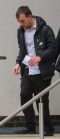

When the police turned up to arrest a Coventry man for money-laundering, they discovered that he had converted the bedroom of his flat into a cannabis factory.
And a judge has rejected cerebral palsy sufferer Philip Davies’s claims that the whole of the crop was for personal use to combat the painful effects of his condition.
But despite that, he escaped being jailed after pleading guilty at Warwick Crown Court to charges of producing cannabis and converting criminal property.
Davies (30) of Lillington Road, Coventry, was sentenced to 21 months in prison suspended for two years and made subject to a 6pm-5am electronically-tagged curfew for three months.
Prosecutor Ian Windridge said that in September 2016 a man received a call purporting to be from his bank asking him to return the call, upon which he was asked some security questions and to provide information about his account.
Then over the next five weeks there were transfers totalling £20,300 from his account into Davies’s account, from which Davies almost immediately made withdrawals.
When the police were contacted about the fraud, they were able to trace the payments to Davies, who later accepted getting a cut for allowing the money to pass through his account.
And when they turned up at his home to arrest him for laundering the money from the fraud, they discovered a large tent in his bedroom in which there were 32 young cannabis plants.
They were being grown with the aid of about £800 worth of equipment, including growing lights, fans and a filter.
Drug expert Dc Paul Shields told the court that, based on the standard range of yields, the eventual crop from the 32 plants could have been worth anything between £5,000 and £26,000.
Davies had entered his guilty plea on the basis that he was growing the whole crop purely for personal use.
His barrister Peter Cooper said Davies was growing it for ‘medical reasons,’ to relieve the pain caused by cerebral palsy, which had led to him having a series of operations on his feet, culminating in the amputation of a toe in 2010.
Deputy Judge Richard Griffith-Jones commented: “I could readily accept his motivation for growing at least some of this was for his own benefit. The issue is whether it was a quantity which was all for his own benefit.”
Giving evidence on that, Davies said he had been using cannabis on a daily basis for about three years before his arrest to help with the pain caused by cerebral palsy, at a cost of ‘£20 a day, seven days a week.’
He said he had undergone operations to straighten his toes, but one became infected and had to be amputated, following which he received a £10,000 medical negligence settlement in 2016.
Asked by Mr Cooper whether he had spent it wisely, Davies replied: “No, I just spent it on things like phones, going for meals, clothes and weed. It lasted about two months, not long.”
Of the cannabis, he said: “I decided to grow some myself, because people used to take the mick and under-weigh my weed.
“I wasn’t going to sell it to anyone or give it to anyone, because if the word got out that I was growing cannabis, my flat door would have come in.”
And Mr Cooper argued that although the plants could have produced far more than Davies realistically needed, it was his first grow, so he did not know how many plants would succeed – and the set-up could not have supported all 32 plants to maturity.
But Judge Griffith-Jones ruled: “I am afraid I have come to the sure conclusion that the prosecution are correct in making the allegation they do.”
He said he believed Davies was growing the crop largely for someone else’s benefit, most likely the person who provided the equipment and the cuttings, although a small percentage of the crop may have been his benefit for doing so.
“He is a man who would be easily used. The sort of people who are put into the front lie and run the risk of being caught are often manipulated by more seasoned criminal.”
Mr Cooper commented: “It is a somewhat sad situation for someone who overcame considerable difficulties to live a blameless life for the first 28 years of it.”
Sentencing Davies, the judge told him: “I am afraid I found you to be a liar when you gave evidence to me.
“Normally a sentence of immediate imprisonment of the order of two years would be entirely justified – but it is obvious to me you are a highly vulnerable man, easily spotted by the wicked eye of a seasoned criminal to be a front-line soldier. Absent that influence, you are capable of keeping out of trouble.”