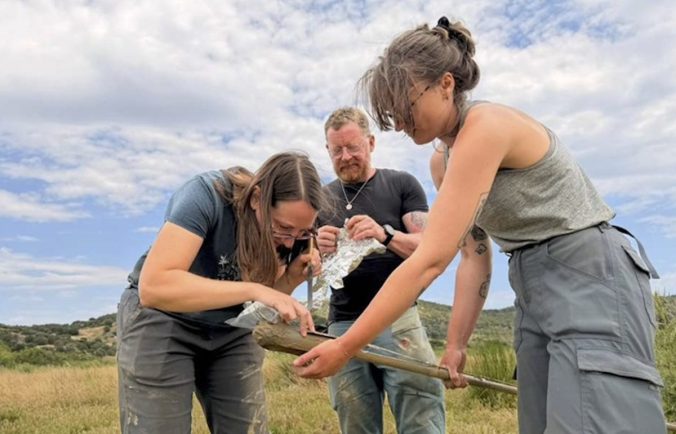
A researcher from Coventry University is helping lead a major new study into the lives of ordinary people in ancient Greece, moving the historical spotlight away from cities and elites and onto rural communities, women and children.
Dr Michelle Farrell, Assistant Professor at Coventry University’s Research Centre for Agroecology, Water and Resilience (CAWR), is overseeing the environmental research strand of the Attica Regional Integrated Environmental and Material Survey, known as ARTEMIS.
The project has secured backing from the Arts and Humanities Research Council to examine the rural past of ancient Greece in greater depth than previous studies have managed.
The five-year project is being led by Dr Maeve McHugh of the University of Birmingham, with Dr Farrell working alongside academics from the University of Patras and the University of Innsbruck, as well as the Ephorate of Antiquities of East Attica. The British School at Athens is also a partner, and archaeological work on the ground is being directed by Dr Eleni Andrikou, Ephor of Antiquities of East Attica.
The team’s focus is Brauron, an ancient site in eastern Attica once closely associated with the lives of Athenian women and girls. By combining archaeological evidence with environmental and climate data, the researchers hope to reconstruct what the landscape around Brauron once looked like and how people used it.
Dr Farrell said the project was designed to broaden the historical record beyond the perspectives that usually dominate it. She explained that ancient histories tend to be told through the experiences of elites and city-dwellers, and that ARTEMIS instead aims to bring the experiences of rural communities into view. Cities, she noted, depended heavily on the countryside to support them, so understanding rural life, and the environment that shaped it, is essential to understanding the ancient world as a whole.
Her particular contribution involves analysing ancient pollen records, working with colleagues in Innsbruck and Patras to track how land cover in the region changed over time. This should reveal what crops were being grown, where, and how farming patterns shifted across different periods. Working alongside the Birmingham team’s research into historic climate change, she also hopes to establish links between shifts in climate and changes in how the land was farmed and managed.
One of the technical challenges facing the team is that the statistical models typically used to interpret pollen data were originally built using evidence from North America and northern Europe, regions with very different vegetation to the Mediterranean. Dr Farrell said this has left a gap in the calibration data needed to apply the technique reliably to Mediterranean plant species, since researchers don’t yet have good estimates of how much pollen different local plants produce. Filling that gap is one of the project’s aims, and she said the resulting datasets should make this kind of modelling far more usable for researchers working elsewhere in the Mediterranean in future.
ARTEMIS began in the summer of 2025 and is now entering its second year. Alongside the fieldwork and analysis, the project includes plans for public engagement activities and community events, both in Greece and further afield.
More information on Coventry University’s Research Centre for Agroecology, Water and Resilience is available via the university’s website.