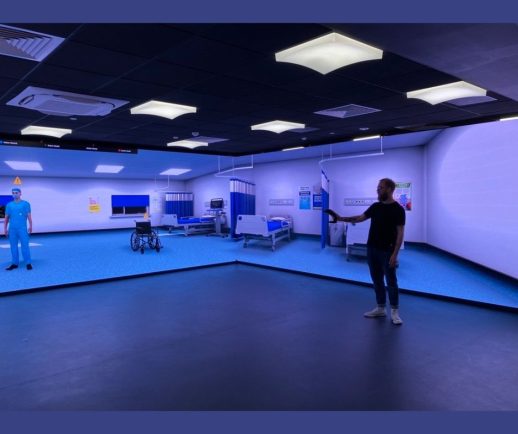
AFTER A £3million investment at Coventry University, healthcare and engineering students are being trained using the latest immersive technology.
The School of Health and Care has opened its new VR Cave Automatic Virtual Environment (CAVE) suite and the College of Engineering Environment and Science has installed a Powerwall.
The suite is funded from a grant by the Office for Students and has a stimulation screen wrapped around three walls which have different scenarios and settings.
Students can also interact with stimulated patients using 3D headsets.
The Powerwall is a floor to ceiling high-definition screen with 3D immersive technology allowing students to work together on projects using advanced visualisation tools.
The CAVE allows students to zoom in on organs and better understand their structure and how they work.
They can practice patient interactions, treatment procedures, and diagnostic techniques specific to courses including diagnostic radiography, occupational therapy and physiotherapy.
Dr Natasha Taylor, curriculum lead for healthcare simulation said: “The CAVE is a totally immersive environment, it allows our learners at the touch of a button to move between environments such as a hospital ward, an operating theatre, the back of an ambulance or outside.
“We also have a model viewer that allows our learners to take parts of the body and look at them in depth, move them around and even go inside them.
“Simulation is threaded throughout all our curricula here at Coventry University, it’s a central pillar of what we do.
“It’s really important that our students can learn in a completely safe environment that allows them to make mistakes, and learn from their mistakes so when they go out into actual practice and see actual people they feel confident and competent.
“In our experience our learners really enjoy and benefit from simulation.”
The Powerwall lets students display a design on screen and interact directly with it, allowing them to zoom in and see it from all angles.
Hardeep Nandra, technical skills advisor said: “This is a high capability, high-definition screen, capable of 3D imagery with tracking software which allows you to fully immerse with the screen itself.
“It gives students the chance to interrogate their designs, you can see right into the components and drawings, allowing learners to critique any areas that they might want to redesign.
“It’s an ideal tool for students in the department to use for their learning.”