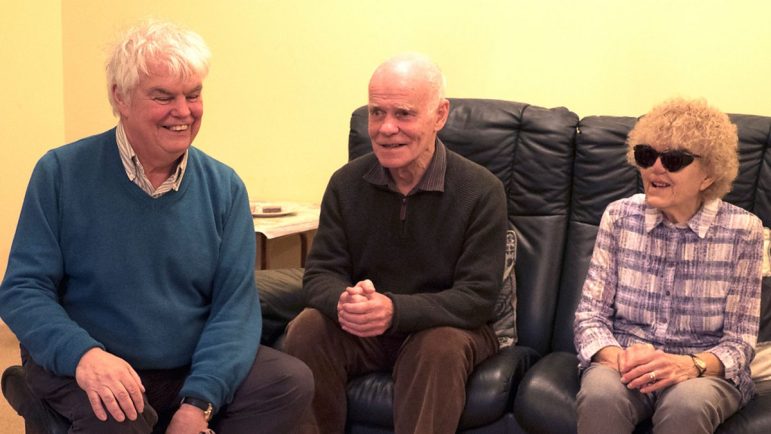

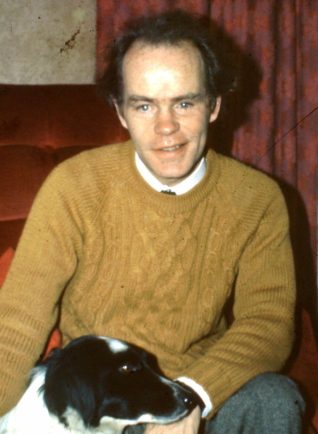

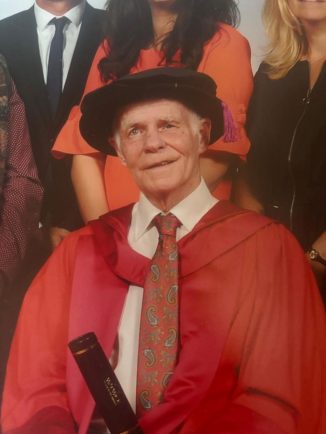
DR FRED Reid, a distinguished historian, author, and inspirational campaigner for the rights of blind and visually impaired people, has died, aged 87.
Born in Glasgow with humble beginnings, he was totally blind from the age of 14 from detached retina. He overcame the odds to become a historian and an honorary professor at the University of Warwick.
Fred met his wife Etta, also blinded in childhood, at the Royal Blind School in Edinburgh. Etta was an NHS physiotherapist at the former Warneford Hospital in Leamington and they raised three children together.
In 2017, both Fred and Etta received honorary doctorates (Honorary Doctor of Letters – Dlitt) at the University at Warwick for their voluntary services to fellow visually impaired people. Their contributions included setting up and running the Kenilworth Reader and Visitor Service for decades, which still sends sighted volunteers to read anything from letters and books to visually impaired people in their own homes in Warwickshire.
Fred passed away at home in Kenilworth, Warwickshire, after a short illness on Saturday, March 29, 2025.
Former Labour Prime Minister Gordon Brown described Reid as a “great of our time”, in a Radio 4 documentary in 2015 about Labour party founding figure Keir Hardie, which heavily featured Fred’s biography of Hardie. (Keir Hardie the Making of a Socialist, Croom Helm, 1978, republished by Routledge 2018). Among Fred’s other diverse published works is Thomas Hardy and History (Palgrave Macmillan, 2017).
His campaigning work included fighting discrimination and advancing the causes of blind and disabled people in employment and training.
BBC broadcaster Peter White told Radio 4’s In Touch programme, for which Fred was a regular contributor and which featured a tribute to Reid this week: “He was one of the most effective of campaigners on behalf of blind and partially sighted people.
“With his mischievous sense of humour, he would have understood the irony of it (the programme’s forthcoming longer tribute piece) being delayed by the concerns about benefits for blind people, over which he campaigned for so long. Farewell Fred, and thank you.”
Gordon Brown, who, when at Edinburgh University several years after Fred, was partially blinded in an accident playing rugby, said he had “benefited from Fred’s kindness when, having lost the sight in my left eye, I faced operations to save the sight of my other eye. Fred was an inspiration, sending me a tape of history books.
“I have nothing but admiration and gratitude for all he has achieved as an author and his contribution to scholarship and the study of history and literature, but also as a campaigner for rights.”
Fred contributed to several government programmes including disability living allowance, access to work, mainstream education for visually impaired children and the first inclusive college for visually impaired students, opened by the RNIB in Loughborough.
He served as President of the National Federation of the Blind and Partially Sighted from 1972 to 1975 and as a trustee of The Royal National Institute of the Blind (RNIB) from 1974 to 1987 (and again from 1999 to 2006). He maintained that the rights of blind people could not be separated from rights for all disabled people, and he also served on The Disability Income Group and the Disability Alliance.
Fred was born to Margaret and his namesake father Fred Reid, a railway worker who went on to hold prominent roles for the National Union of Railwaymen in Glasgow and the west of Scotland. Fred junior attended Shawlands Academy, and Socialist Sunday school.
He went on to University of Edinburgh from 1958, graduating with first class honours in History, before obtaining a PhD at The Queen’s College, Oxford University in 1967.
He was a lecturer at the then new University of Warwick from 1966, alongside celebrated historian EP Thompson, who influenced Reid’s work. Reid retired from Warwick in 1997.
His son, Les Reid, a journalist, said on the family’s behalf: “While we mourn his loss, we will all celebrate his unique and inspirational long life. Even in his final weeks, he was an example to all, showing remarkable mental strength, dignity and empathy, and retaining his sense of humour.
“He had enough time to say goodbye to family and friends and conclude directions for his autobiography to be finished.”
Professor Christopher Read, Emeritus Professor of History at the University of Warwick, said of his former colleague and close friend: “I don’t like to use the word inspirational since it is such a cliche but, in Fred’s case, it applies in its deepest and real sense.”
His interests over the years included cycling, mountaineering, classical music and theatre, ‘but best of all has been my family’, he added in an online biography.
Fred is survived by Etta, sons Les and Gavin, a scientist, and six grandchildren. Their daughter Julie, a Guardian production editor and journalist, sadly passed away in 2024 aged 56. In a notable feature in 2006, Julie wrote about growing up with blind parents in Kenilworth.
- Listen to Fred and Etta on BBC4’s In Touch programme.