EYES in the sky are flying over Coventry to catch criminals and keep residents safe.
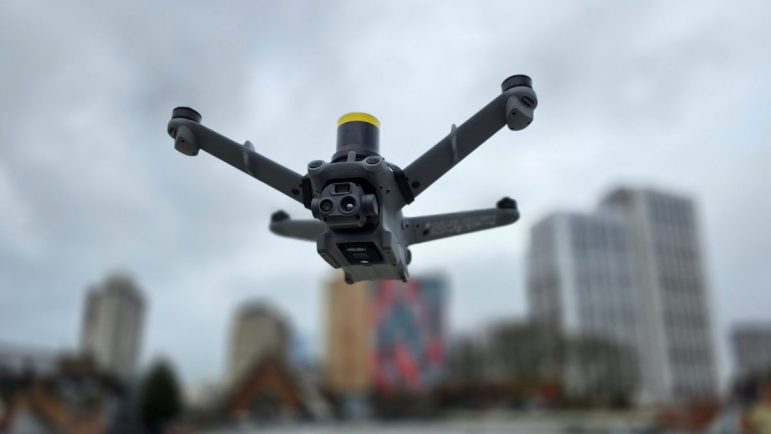
Drones operated by West Midlands Police are launched from automated charging stations on the roof of a city centre building when an incident is reported nearby.
They use cameras to assesses situations, capture evidence and track suspects, relaying important information to officers on the ground.
It’s the latest phase in a project known as Drone First Responder, which has already seen the technology operate from University Hospital Coventry and junction nine of the M6.
Although drones must currently be flown by a pilot at the location and within their line of sight – limiting their range to around 500 metres – the police drones in Coventry are operated by pilots based in the force’s Birmingham control centre, and can operate within a 2.5km radius.
Led and funded by the National Police Chief’s Council (NPCC) as part of the national Beyond Visual Line of Sight Pathways Project, the project explores the effectiveness of drones at assessing scenes before officers arrive on site, informing resourcing decisions, gathering early visual evidence, and tracking suspects.
A West Midlands Police spokesperson said: “For the past 12 months, the remotely operated drones have saved hours of officer time, improved safety, helped them make better decisions and ensures the right organisation responds to the incident – whatever it may be.”
The drones have been used to track a man who had reportedly strangled a woman, locate a teenager reported to have a gun, help with the search for a high-risk missing person, and pinpoint the precise location of dangerous debris on the motorway.
Assistant Chief Constable Matt Welsted from the Force Executive team said: “Working with the Civil Aviation Authority, the project is fully funded by the Home Office via the NPCC. This includes the costs of staffing, meaning we get extra resources to prevent and detect real crimes, affecting the communities we serve.
“As if that was not enough, we benefit from all of the learning in real-time, while shaping British policing’s future use of drones, further cementing our national reputation as leaders in the use of technology in policing.
“Drone First Responders is a hugely exciting innovation related to the very latest capability around police use of drones.
“We’ve got two operating in Coventry – because it’s a ‘drone ready city’ and they are amazing at getting quickly to the scenes of incidents that we need to understand what’s happening, gather evidence and keep the public safe.”
The new drones are fitted with thermal imaging, parachutes, and weather monitoring technology which can order them to land if conditions become dangerous.
Drone as First Responder NPCC lead, Supt Taryn Evans, said: “National guidelines say that police forces must arrive at emergencies as a soon as possible, but within 15 minutes. Traffic jams and road closures can cause delays – challenges that do not affect drones.
“Having them already securely stored and fully charged in areas of high demand will further speed up their arrival time, while providing the officers who are on their way with important information. It will also help us secure the help of partner agencies quickly.
“Multiple drones could attend the scene, monitor and track suspects, and complete searches for evidence or witnesses.
“The image from the drone will get sent directly to the officers approaching and to the control room which is making decisions about that event so that they can see what’s happening before they get there and make decisions about how to approach it accordingly.”
Visit www.caa.co.uk/drones for information on flying drones.