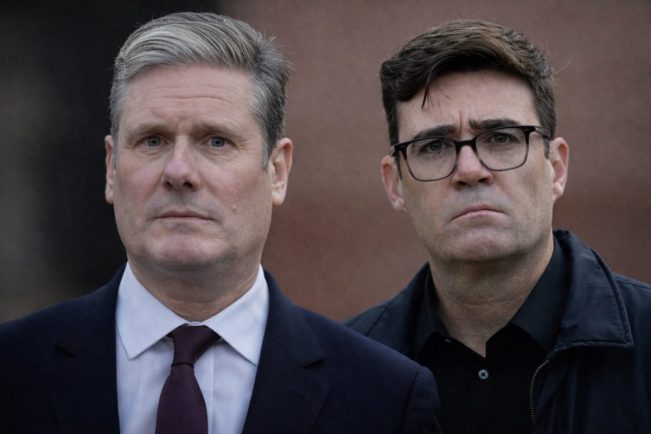
Andy Burnham has been dramatically blocked from returning to Westminster after Labour’s ruling body rejected his bid to stand in a by election, a move that has exposed raw divisions at the top of the party and risks plunging Sir Keir Starmer into a fresh internal crisis.
A panel of Labour’s National Executive Committee met on Sunday and voted eight to one against allowing the Mayor of Greater Manchester to contest the Gorton and Denton seat.
In a striking sign of discord, Lucy Powell, the party’s deputy leader, was the sole supporter of his application.
Shabana Mahmood, the Home Secretary and chair of the NEC, abstained, with sources suggesting she wished to remain formally neutral because of her role overseeing the process.
Mr Burnham had announced only a day earlier that he wanted to run in the by election, a move widely interpreted at Westminster as the opening shot in a potential leadership challenge should he make it back onto the Commons benches. However, his ambitions depended on securing the blessing of the NEC, which is dominated by figures close to the Prime Minister.
Sir Keir’s supporters privately argued that allowing the Manchester mayor to stand would have been reckless, warning it could have handed Reform UK a chance to seize control of the city in a subsequent mayoral election. They accused Mr Burnham of putting his own career ahead of the party, since his departure from City Hall would have triggered a costly new vote across Greater Manchester.
Yet the decision to block him has provoked an immediate backlash from Labour’s Left and soft Left, who see it as a blatant attempt to kneecap a possible rival.
Mainstream, the group closely aligned with Mr Burnham, demanded a rethink, saying Labour should reverse the ruling if it was serious about confronting Reform and building a credible team in Parliament.
Veteran Corbyn ally John McDonnell went further, branding the verdict a “disgusting decision” and accusing Sir Keir of cowardice rather than magnanimity. Posting online, he warned it would only accelerate the Prime Minister’s downfall.
Louise Haigh, the former transport secretary, called the move disappointing and urged the leadership to change course, arguing that blocking one of the party’s most recognisable figures only highlighted Labour’s struggle to connect with voters.
She said it was absurd for the leadership to feel threatened by a popular politician and warned that the party could come to regret the decision if it doubled down.
Other MPs were blunter still. Jon Trickett, who represents Normanton and Hemsworth, said preventing members from having a full choice of candidates revealed weakness and a lack of confidence in Downing Street.
One Left wing backbencher described the leadership as looking “absolutely p$£@ weak”, predicting the row would embolden rivals such as Wes Streeting to manoeuvre for the top job. The MP added that while the outcome had been predictable, it did not make it any less pathetic.
Sir Keir’s camp has sought to present the decision as pragmatic rather than political. Allies insisted that a mayoral contest would have drained party funds and risked Reform capturing one of Labour’s most important urban strongholds.
One senior supporter warned that forcing a new election in Manchester would have sparked a nasty and divisive campaign and questioned whether the ambition of one man was worth the gamble.
Communities Secretary Steve Reed echoed that line, telling broadcasters that voters did not want an unnecessary mid term election and that Greater Manchester residents had chosen Mr Burnham for a four year mandate only two years ago.
He said the party would instead select a different candidate for Gorton and Denton and focus on defending the government’s record.
Behind the scenes, however, the blocking of the so called “King of the North” has only fuelled speculation about Labour’s brittle state after months of policy reversals, internal briefings and falling poll ratings.
Supporters of the Prime Minister have also pointed to Mr Burnham’s past comments, including a warning last autumn that Labour was “in hock to the bond markets”, remarks they say unsettled investors and pushed up borrowing costs.
Despite that, the mayor had drawn backing from senior figures including Ed Miliband, Sir Sadiq Khan and Ms Powell, while Mr Streeting previously criticised hostile briefings against him even as he stopped short of full endorsement.
With Mr Burnham now sidelined, attention is turning to who might benefit most from the fallout. Angela Rayner and Mr Streeting are both seen as potential future contenders, and the row has handed disgruntled MPs a fresh grievance to nurse.
Labour’s chosen candidate in Gorton will face a stiff test from Reform, which came second there in 2024, after sitting MP Andrew Gwynne announced he would step down amid an ethics investigation over leaked abusive messages.
Many within the party fear that if Labour were to lose the seat now that Mr Burnham has been barred, the consequences for Sir Keir could be devastating.
Mr Burnham, who has twice sought the Labour leadership and served in Gordon Brown’s Cabinet, is also expected to feel freer to criticise Number 10 from the outside. Allies say he has never hidden his desire to one day occupy it himself.
For a party that came into power promising unity and competence, the spectacle of senior figures tearing strips off one another, MPs briefing anonymously and factions sharpening knives will only reinforce the impression of a government looking inward, distracted, and increasingly rattled.
Image: For illustration purposes