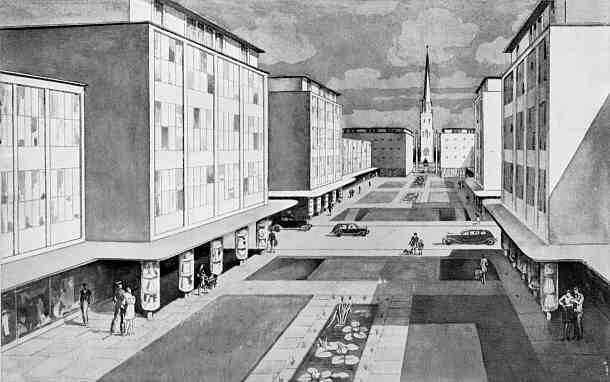
THREE men who helped shape Coventry after the Blitz have been included in the Oxford Dictionary of National Biography.
The trio of town planners and designers – Sir Wilfred Burns, Percy Edwin Alan Johnson-Marshall, and Frederick Bernard Pooley – were added to the dictionary following work by Warwick University History of Art researcher Dr Otto Saumarez Smith, who was an advisory editor and key contributor to the update.
* Sir Wilfred Burns (1923-1984) – whose approach to planning was formed while an assistant planning officer at Coventry, which he described as ’by far the most ambitious and inspiring scheme in the country, and the plan most likely to fit in with contemporary and future society’. He was later head of planning at Newcastle upon Tyne, who sacrificed important aspects of its Georgian townscape for a new shopping centre and roundabout.
* Percy Edwin Alan Johnson-Marshall (1915-1993) – became senior assistant architect of Coventry’s newly formed city architect’s department in 1938, and he helped organize the exhibition ‘Coventry of Tomorrow’. His first wife was killed in the Coventry air raids. He later set up in private practice in Edinburgh, and his ideas were set out in his book Rebuilding Cities.
* Frederick (Fred) Bernard Pooley (1916-1998) – was deputy city architect at Coventry, where he worked on the precinct, and he introduced high-rise blocks in Tile Hill. He was chief architect for Buckinghamshire, remembered though for his concrete tower in Aylesbury and his uncompleted monorail plan for North Buckinghamshire.
Dr Otto Saumarez Smith said: “Britain’s post-war urban planners are regularly held up as bogeymen, responsible for a variety of calamities, from the despoliation of historic buildings, to the breakup of traditional communities, and the imposition of gimcrack, over-scaled, ugly, concrete monstrosities on comfortably traditional townscapes.
“The hostility towards this profession is exemplified by by Prince Charles’ statement that ‘You have to give this much to the Luftwaffe. When it knocked down our buildings, it didn’t replace them with anything more offensive than rubble. We did that.’
“These Oxford DNB entries are a contribution to the ongoing reassessment of these controversial figures. They attempt to understand, rather than merely castigate, the profession at the heart of the unparalleled physical transformation of urban Britain in these years.
“The subject is hugely important because of the profound effect it had, and continues to have, on everyday lives and places across the country.”
The Oxford DNB is the national record of men and women who have shaped British history, worldwide, from pre-history to 2015. It includes biographies of 63,261 men and women, written by over 10,000 contributors.
It is freely accessible in most public libraries.