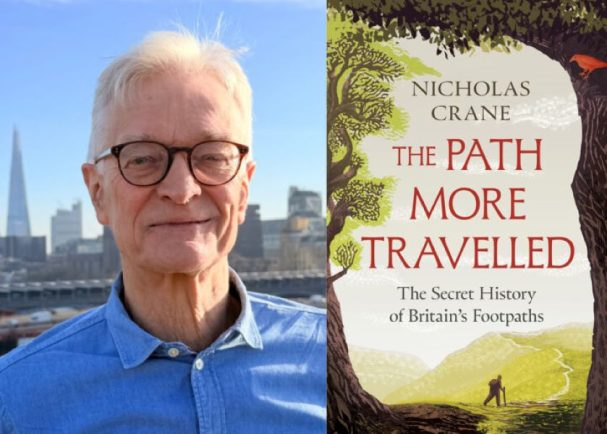
NICHOLAS Crane pulls on his walking boots to explore the history of Britain’s highways and byways in The Path More Travelled.
The geographer, writer and broadcaster takes the reader on a 12,000 year hike through an ever-changing landscape, following the pioneering prehistoric men and women who made their way to these shores across Doggerland at the end of the last ice age more than 11,000 years ago, through to the fast lane life of the modern world dominated by the all-conquering internal combustion engine.
It’s a history spent mostly on two feet, then the four legs of the horse, before the wheel arrives, which eventually accelerates the transformation of this land far beyond the wildest imagination of those who walked these shores in centuries gone by.
It is chiefly a celebration of walking and concludes with a rallying cry to open up more of the land to its people. While acknowledging the tireless efforts of organisations such as the Open Spaces Society, the Ramblers, the Campaign for the Protection of Rural England, Sustrans and wildlife trusts, among many others, he makes it clear there is still much work to be done
His thoroughly engaging journey takes the reader on a ramble up mountain and down dale, across ancient tracks, around field paths, along canal towpaths, bridleways and cycleways, and down city pavements and alleyways.
Much of the pre-Roman story of man’s movement in prehistoric Britain is one of conjecture and debate, but while real evidence of early footprints may literally be light on the ground, we know for certain the land was criss-crossed with a web of routeways, and that our ancestors, particularly from the Bronze Age onwards, would travel great distances, even if we may not be sure exactly why. Personal enlightenment? Gift exchange? Dating? Spiritual observance? All and quite probably more.
The Romans certainly left their mark during their 400 year stay, bringing systematised road building and a planned network of communication to Britain for the first time. When they left so did any real continuity for the best part of the next couple of millennium.
Later came the land-grabbing Norman barons, who arguably did more than anyone else to close off the country to the majority of the population. They came, they conquered and they put up the ‘keep out’ signs. They kicked-started the enclosure of the countryside.
Efforts to improve roads saw the first Highways Act in 1555 – nine years before Shakespeare was even born – aimed at maintaining the nation’s roads. Too broadly worded, it had little real impact. Turnpikes – tolled roads – did manage to improve things a little later, but it was the mass arrival of the car in the 20th century which was to make the most marked difference to the nation’s road system, and which continues to do so.
Before then saw the industrial revolution change the landscape of Britain, with the growth of cities and the arrival of the canals and railways.
War also played its part, with swathes of land, such as Salisbury Plain, commandeered for military purposes, and then to meet the demand for airfields during the Second World War.
The face of Britain has been one of constant change and adaptation from the moment man first set foot on these isles, and the author is all too aware that is not going to change, but is aware of the health and mental benefits offered by a more open landscape which positively welcomes and encourages more people to get out and enjoy what’s on their doorstep. “Slower travel as lifespan gained” as he coins it.
The Path More Travelled – The Secret History of Britain’s Paths is published by Weidenfeld & Nicolson.
* Nicolas Crane will be appearing at Stratford Literary Festival on May 8. Visit www.stratfordliteraryfestival.co.uk for further details about the festival running from May 7 to 10.